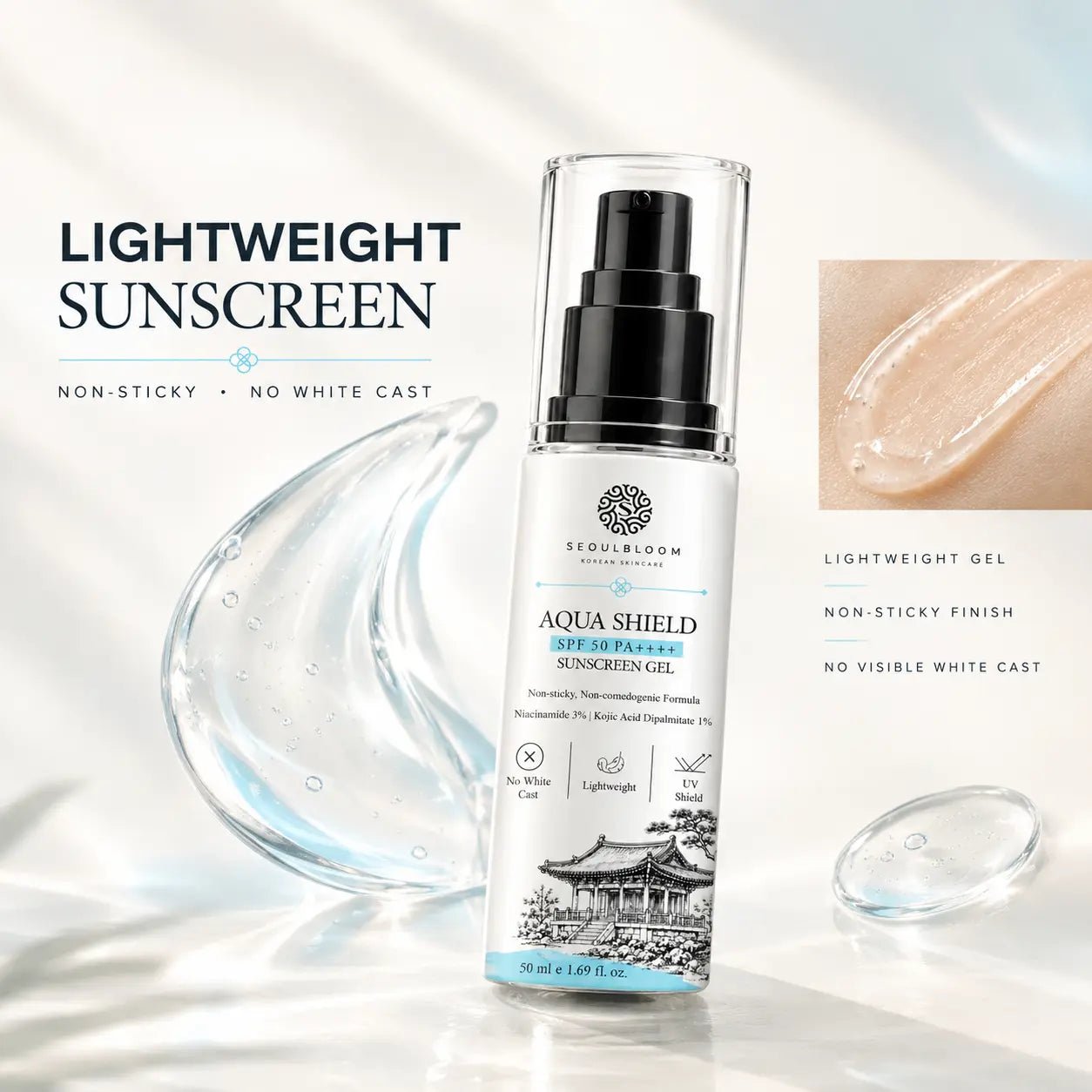
Quick answer: this sunscreen glossary explains every label term in plain language — from SPF, PA++++ and PPD to UV filters like zinc oxide, avobenzone and Tinosorb, and skincare actives like niacinamide.
This sunscreen glossary is an A–Z guide to the words printed on Indian, Korean and international sunscreen packs. Use it to decode ingredient lists, compare products fairly and choose the right formula for your skin.
Jump to: A · B · C · D · E · F · G · H · I · K · M · N · O · P · R · S · T · U · V · W · Z
A
Avobenzone
A widely used chemical UVA filter. It can break down in sunlight on its own, so formulators often pair it with stabilisers such as octocrylene.
B
Bemotrizinol (Tinosorb S)
A modern, photostable broad-spectrum filter that covers both UVA and UVB. It is approved in India, Europe and many Asian markets.
Bisoctrizole (Tinosorb M)
A broad-spectrum filter that works partly like a mineral filter by scattering light, while also absorbing UV.
Broad spectrum
A label meaning the sunscreen protects against both UVA and UVB.
C
Ceramides
Lipids that help the skin barrier hold moisture; useful in sunscreens for dry or sensitive skin.
Chemical (organic) filters
UV filters that mainly absorb UV energy, such as avobenzone, octocrylene and homosalate. They are sheer and common in gels.
Critical wavelength
A lab measure of how far into the UVA range a sunscreen protects. A value of 370 nm or more is commonly used to support a broad-spectrum claim.
D
Dermatologically tested
A marketing term meaning a product was tested under dermatologist supervision. It does not guarantee it suits every skin.
Diethylamino hydroxybenzoyl hexyl benzoate (Uvinul A Plus)
A photostable UVA filter used in many Asian and European sunscreens.
E
Ethylhexyl triazone (Uvinul T 150)
A highly efficient UVB filter that helps formulas reach high SPF with a light feel.
F
Fragrance-free
Contains no added fragrance; a helpful choice for sensitive or reactive skin.
G
Gel sunscreen
A water-based, oil-light sunscreen texture that absorbs fast. Read our gel sunscreen guide.
Glycerin
A classic humectant that draws moisture into the skin.
H
Homosalate
A chemical UVB filter often combined with other filters to raise SPF.
Hyaluronic acid
A humectant that holds water in the skin, making sunscreens feel more hydrating.
Hybrid sunscreen
A formula that combines chemical and mineral filters.
I
In-vivo tested
SPF or PA tested on human volunteers rather than only in the lab.
Iron oxides
Pigments in tinted sunscreens that help block visible light, which can worsen dark spots and melasma.
K
Kojic acid dipalmitate
A stable form of kojic acid used for a brighter, more even-looking complexion.
M
Matte finish
A non-shiny finish that suits oily skin.
Mineral (inorganic) filters
Zinc oxide and titanium dioxide. They absorb and scatter UV, are often gentle, but can leave a white cast.
N
Niacinamide
Vitamin B3. Supports the skin barrier and helps balance the look of oil and uneven tone.
Non-comedogenic
Formulated to avoid clogging pores — important for oily and acne-prone skin.
O
Octocrylene
A UVB filter that also helps stabilise avobenzone.
Oxybenzone
An older chemical filter. Some people avoid it because of allergy and environmental concerns; many newer Indian formulas skip it.
P
PA rating
A UVA protection grade from Japan, shown as PA+ to PA++++. It comes from PPD testing; PA++++ (PPD 16+) is the highest grade.
Photoageing
Skin ageing caused by UV — wrinkles, loss of firmness and age spots — driven largely by UVA.
Photostable
A filter or formula that does not break down quickly under sunlight, so protection lasts longer.
PPD (Persistent Pigment Darkening)
A test that measures how much longer protected skin takes to darken under UVA. It is the basis of PA ratings.
R
Reef safe
A loosely defined marketing term, usually meaning the product avoids oxybenzone and octinoxate. It is not a regulated standard.
S
SPF (Sun Protection Factor)
A measure of protection against UVB. SPF 30 filters about 97% of UVB and SPF 50 about 98% when applied correctly.
Sunblock
An old term for sunscreen, often used for mineral formulas. Today ‘sunscreen’ is the standard term.
T
Tinted sunscreen
A sunscreen with pigments (usually iron oxides) that adds light coverage and helps against visible light.
Titanium dioxide
A mineral UV filter that is especially effective against UVB and short UVA.
U
UV index
A 0–11+ scale of the sun’s UV strength. Read our UV index guide for India.
UVA
Long-wave UV that penetrates deeper into skin and drives tanning, pigmentation and photoageing. It passes through clouds and window glass.
UVB
Shorter-wave UV that causes sunburn. SPF numbers describe protection against UVB.
V
Visible light
Light we can see. High-energy visible light can worsen pigmentation, especially in deeper skin tones; tinted sunscreens help.
W
Water resistant (40 / 80 minutes)
Under US FDA rules, a sunscreen can claim water resistance only for 40 or 80 minutes of swimming or sweating, and no sunscreen is ‘waterproof’.
White cast
The grey or chalky tint some sunscreens (often mineral) leave on medium and deep skin tones.
Z
Zinc oxide
A mineral filter that covers both UVA and UVB; often well tolerated by sensitive skin.
How to use this glossary when shopping
- Check the front label for broad spectrum, SPF and PA.
- Scan the first ingredients for the UV filters listed here.
- Look for helpful actives for your skin type, such as niacinamide or ceramides.
- Watch for fragrance or high alcohol if your skin is sensitive.
Sources: AAD, US FDA, Wikipedia.