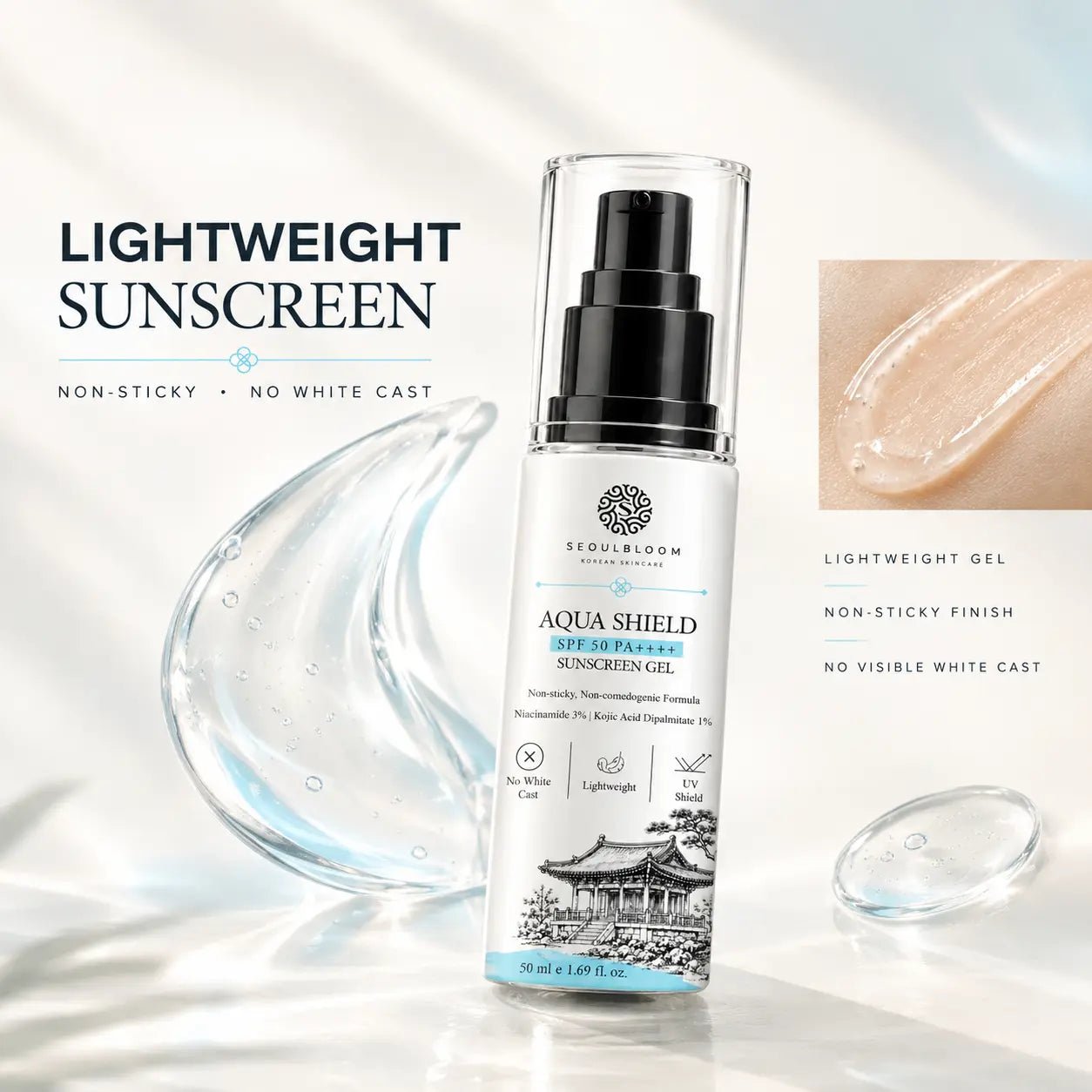
Quick answer from this sunscreen guide: the best sunscreen is a broad-spectrum SPF 30–50 with PA+++ or PA++++, in a texture you will wear daily. Apply two finger-lengths for face and neck, 15 minutes before going out, and reapply about every two hours outdoors.
This complete sunscreen guide explains everything you need to choose and use sunscreen in India — how sunscreen works, what SPF and PA really mean, chemical vs mineral filters, gel vs cream, the right sunscreen for your skin type, and how to apply it properly. Every claim links to dermatology and public-health sources.
On this page
What is sunscreen and how does it work?
Sunscreen is a skincare product that contains UV filters. These filters absorb, scatter or reflect ultraviolet (UV) radiation before it damages skin cells. Without protection, UV exposure causes sunburn, tanning, dark spots, early wrinkles and a higher risk of skin cancer. In fact, the World Health Organization names UV exposure as the main cause of skin cancers.
A sunscreen works only as well as the film it leaves on your skin. So the amount you apply, how evenly you spread it, and how often you reapply matter as much as the formula itself.
UVA vs UVB: the two rays sunscreen must block
| UVA | UVB | |
|---|---|---|
| Wavelength | Longer (320–400 nm) | Shorter (280–320 nm) |
| Main effects | Tanning, pigmentation, photoageing | Sunburn, redness |
| Passes through glass and clouds? | Yes, largely | Mostly blocked by glass |
| Measured by | PA rating / PPD, broad-spectrum label | SPF number |
Because each ray does different damage, you need protection from both. That is exactly what a broad-spectrum sunscreen provides.
SPF and PA ratings explained
SPF (Sun Protection Factor) measures protection against UVB. The American Cancer Society gives these approximate figures when sunscreen is applied correctly:
| SPF | UVB filtered | Best for |
|---|---|---|
| SPF 15 | ~93% | Short, incidental exposure |
| SPF 30 | ~97% | Daily minimum recommended by dermatologists |
| SPF 50 | ~98% | Strong Indian sun, commutes, outdoor days |
| SPF 100 | ~99% | Rarely needed; small extra gain |
PA (Protection Grade of UVA) measures UVA protection. It comes from Japan and is common on Korean and Indian sunscreens. The grade is based on a Persistent Pigment Darkening (PPD) test:
| PA grade | PPD value | UVA protection |
|---|---|---|
| PA+ | 2–4 | Some |
| PA++ | 4–8 | Moderate |
| PA+++ | 8–16 | High |
| PA++++ | 16+ | Extremely high |
For daily wear in India, an SPF 50 PA++++ sunscreen gives the most headroom, because most people apply less than the tested amount. The WHO also advises choosing a sunscreen that filters both UVA and UVB with SPF 30 or higher.
Chemical vs mineral sunscreen
| Chemical (organic) filters | Mineral (inorganic) filters | |
|---|---|---|
| Examples | Avobenzone, octocrylene, homosalate, bemotrizinol, ethylhexyl triazone | Zinc oxide, titanium dioxide |
| How they work | Mainly absorb UV | Absorb and scatter UV |
| Feel | Sheer, light, no white cast | Can feel thicker; may leave white cast |
| Best for | Oily skin, gels, daily wear | Sensitive skin, kids (with doctor advice) |
Many modern formulas are hybrid, combining both types. Neither type is automatically better. Instead, choose the one that suits your skin and that you will wear consistently. Look up any filter in our sunscreen ingredients glossary.
Gel vs cream and other sunscreen textures
| Texture | Feel | Best for |
|---|---|---|
| Gel / water gel | Weightless, fast-absorbing | Oily, combination, acne-prone skin; humid weather |
| Cream-gel | Light but cushiony | Normal skin, AC offices |
| Cream / lotion | Rich, moisturising | Dry or mature skin; winters |
| Fluid / serum | Very sheer | Makeup wearers |
| Stick | Solid balm | Top-ups on the go |
| Spray | Mist | Body, hard-to-reach areas |
| Tinted | Light coverage | Pigmentation, visible light |
With the same SPF and PA, every texture protects equally. Read our full gel sunscreen guide to see whether a gel suits you.
Sunscreen by skin type
- Oily skin: a lightweight, non-comedogenic gel with a matte finish.
- Combination skin: a gel or cream-gel; add moisturiser only where needed.
- Dry skin: a cream or cream-gel with glycerin, hyaluronic acid or ceramides.
- Sensitive skin: fragrance-free, low-alcohol formulas; patch-test first.
- Acne-prone skin: oil-free, non-comedogenic gels.
See the detailed breakdown in sunscreen by skin type, or take the Sunscreen Finder quiz.
How to choose a sunscreen: 7-point checklist
- Broad spectrum on the label.
- SPF 30 or higher — SPF 50 for long outdoor hours.
- PA+++ or PA++++ for UVA, tanning and pigmentation.
- Non-comedogenic if you are oily or acne-prone.
- Water resistant (40 or 80 minutes) for sport, swimming or heavy sweat.
- Texture and finish you enjoy, so you reapply it.
- Ingredient check: avoid strong fragrance or high alcohol if you are sensitive.
How to apply sunscreen correctly
- Finish your skincare first; sunscreen is the last step before makeup.
- Use two finger-lengths for face and neck.
- Apply in two thin layers for even coverage.
- Cover ears, hairline, neck and the backs of your hands.
- Use an SPF lip balm of at least SPF 30.
- Apply about 15 minutes before going out, as the AAD advises.
- Reapply about every two hours outdoors and after swimming or sweating.
Common sunscreen mistakes to avoid
- Applying a pea-sized amount.
- Skipping sunscreen on cloudy or monsoon days — the AAD notes that clouds let a large share of UV through.
- Relying only on SPF in makeup or moisturiser.
- Forgetting to reapply after sweating.
- Using an expired sunscreen.
- Ignoring the PA rating.
Sunscreen in Indian weather
India has strong UV for much of the year. In humid coastal cities, lightweight gels feel best. In dry North Indian winters, creams or cream-gels prevent tightness. During the monsoon, UV still reaches your skin through clouds, so keep the daily habit. Check our UV index guide for India to plan outdoor time.
Also remember that no sunscreen is waterproof. The US FDA only allows “water resistant” claims for 40 or 80 minutes, so reapply after every swim.
Sunscreen guide FAQ
What is the best SPF for daily use in India?
Use a broad-spectrum sunscreen of at least SPF 30 every day. For long hours outdoors in strong Indian sun, SPF 50 with PA+++ or PA++++ gives more margin.
What is the difference between SPF 30 and SPF 50?
SPF 30 filters about 97% of UVB rays and SPF 50 about 98%. The gap looks small, but SPF 50 leaves more room for real-life under-application.
What does PA++++ mean on sunscreen?
PA rates UVA protection. PA++++ is the highest grade and means a PPD value of 16 or more, which helps against tanning and pigmentation.
Is broad-spectrum sunscreen necessary?
Yes. SPF only describes UVB protection, so a broad-spectrum label confirms that the sunscreen also covers UVA.
How much sunscreen should I apply on my face?
About two finger-lengths covers the face and neck. That amount gets you close to the 2 mg/cm² used in SPF testing.
How often should I reapply sunscreen?
Reapply about every two hours outdoors, and immediately after swimming, sweating or towel-drying.
Is sunscreen needed indoors?
If you sit near windows or step out at all, yes. UVA passes through window glass, so a morning layer is the simplest habit.
Can I use body sunscreen on my face?
You can, but face sunscreens are usually lighter and less likely to clog pores. If your skin is acne-prone, choose a non-comedogenic face formula.
Does sunscreen expire?
Yes. Check the expiry date, keep it away from heat, and replace it if the colour, smell or texture changes.