Quick answer: What is sunscreen? It is a topical product with UV filters that absorb or scatter ultraviolet rays before they damage skin. SPF shows protection against UVB burning, while PA or “broad spectrum” shows UVA coverage. Dermatologists advise SPF 30 or higher, applied generously and reapplied every two hours outdoors.
Key takeaways
- Sunscreen uses chemical or mineral UV filters to cut the UV that reaches your skin.
- SPF measures UVB (burning) protection; SPF 30 filters about 97% of UVB.
- PA+++ or PA++++ and “broad spectrum” show UVA protection, key for tanning and pigmentation.
- Use about 2 mg/cm², roughly a shot glass for the body, and reapply every two hours outdoors.
- Babies under six months should not use sunscreen; ask a paediatrician instead.
What is sunscreen, really, and why does every dermatologist keep telling you to wear it? Most people use it without knowing what the numbers on the tube mean. As a result, they pick the wrong type, apply too little and still tan.
This guide fixes that in plain language. First, we explain how UV filters work. Next, we decode SPF, PA and broad spectrum, with tables built for Indian skin and weather. Finally, we cover how much to apply, who should be careful and which myths to ignore.
In this article
- What is sunscreen, in simple words?
- How does sunscreen work on your skin?
- What are UVA and UVB rays, and why do they matter?
- What does SPF on a sunscreen mean?
- What do PA ratings and “broad spectrum” mean?
- Where did SPF and modern sun protection come from?
- What types of sunscreen can you buy in India?
- Why should you wear sunscreen every day?
- How much sunscreen should you apply, and how?
- Who needs sunscreen, and are there exceptions?
- How do you read a sunscreen label quickly?
- What are the most common sunscreen myths?
- Is sunscreen enough on its own?
- FAQ
What is sunscreen, in simple words?

Sunscreen is a skincare product that you spread on your skin to reduce the ultraviolet (UV) radiation reaching it. In other words, it works like a thin, invisible filter between your skin and the sun. It does not block every ray. Instead, it cuts the dose of UVA and UVB enough to lower sunburn, tanning and long-term damage.
Every formula has two parts. First, there are the active UV filters that do the protecting. Second, there is the base: water, emollients, thickeners and preservatives that make it spreadable. According to Live Science, active filters make up roughly a fifth of a typical product. The rest decides texture, finish and how it feels in a humid Mumbai afternoon.
Regulation also differs by country. For example, the US FDA treats it as an over-the-counter drug, while some countries regulate it as a cosmetic. Either way, the job stays the same: daily protection against UV damage. For the bigger picture, our complete sunscreen guide covers every basic in one place.
How does sunscreen work on your skin?

Sunscreen works by absorbing UV energy, and to a smaller extent scattering or reflecting it, before it can damage skin cells. Two broad families of filters do this job. Many modern formulas combine both for wider coverage.
Chemical (organic) sunscreen filters
Chemical filters are carbon-based molecules such as avobenzone, octocrylene, homosalate and bemotrizinol. They absorb UV rays and then release that energy as a tiny amount of heat. Because they dissolve into the formula, they usually feel light and leave no white cast. However, some people with reactive skin find them more irritating. Live Science notes they may need around 20 minutes to start working well.
Mineral (inorganic) sunscreen filters
Mineral filters are zinc oxide and titanium dioxide. They sit on top of the skin and work from the moment you apply them. Contrary to the old “mirror” idea, research summarised on Wikipedia shows they mainly absorb UV, with some scattering. The AAD suggests mineral formulas for sensitive skin. On the other hand, they can leave a white or grey cast on medium and deep Indian skin tones.
| Feature | Chemical filters | Mineral filters |
|---|---|---|
| Examples | Avobenzone, octocrylene, bemotrizinol | Zinc oxide, titanium dioxide |
| Main action | Absorb UV, release heat | Mostly absorb, partly scatter UV |
| Starts working | About 20 minutes after applying | Right away |
| White cast | Rare | Possible, especially at high SPF |
| Best for | Oily skin, daily wear under makeup | Sensitive or easily irritated skin |
What are UVA and UVB rays, and why do they matter?
UVA and UVB are the two kinds of solar UV that reach the ground. Put simply, UVB mainly burns the surface, while UVA goes deeper and drives tanning, dark spots and ageing. UVA sits at roughly 315 to 400 nanometres, a longer wavelength than UVB.
The World Health Organization lists sunburn, DNA damage, premature skin ageing and skin cancers among the effects of UV. It also links UV to eye problems such as cataract. Therefore, a good formula must cover both bands, not just the burning one.
India adds extra reasons to care. Many cities sit close to the equator, and summer afternoons are long and bright. Moreover, brown skin may not burn easily, yet it tans and pigments readily. As a result, UVA protection matters as much as SPF here. You can check daily levels on our UV index page; WHO advises sun protection whenever the UV index reaches 3 or more.
What does SPF on a sunscreen mean?
SPF, or Sun Protection Factor, tells you how well a sunscreen protects against UVB and sunburn. It does not measure UVA. In theory, SPF 30 lets through about 1/30 of the burning rays, so roughly 97% gets filtered, as the American Academy of Dermatology explains.
Labs test SPF at a thick layer of 2 mg per square centimetre. Most people apply far less, so real-world protection drops. Also, a higher number does not mean the product lasts longer. You still need to reapply about every two hours outdoors.
| SPF | Share of UVB reaching skin (approx.) | UVB filtered (approx.) | Good for |
|---|---|---|---|
| SPF 15 | 1/15 (about 7%) | About 93% | Minimum; brief errands only |
| SPF 30 | 1/30 (about 3%) | About 97% | Daily use; AAD minimum |
| SPF 50 | 1/50 (about 2%) | About 98% | Long outdoor days, commutes, travel |
Clearly, the jump from SPF 30 to SPF 50 is small on paper. Even so, SPF 50 gives a useful buffer when you apply too little, which most of us do.
What do PA ratings and “broad spectrum” mean?
PA ratings and the words “broad spectrum” tell you whether a product also guards against UVA. The PA system comes from Japan and is common on Korean and Indian labels. It is based on PPD, or persistent pigment darkening, a test of how much UVA it takes to darken skin.
| PA rating | PPD (UVA protection factor) | What it means for you |
|---|---|---|
| PA+ | 2 to 4 | Some UVA protection |
| PA++ | 4 to 8 | Moderate UVA protection |
| PA+++ | Above 8 | High UVA protection |
| PA++++ | 16 or more | Very high; ideal for tanning and pigmentation |
Meanwhile, “broad spectrum” is the US label term. It means the product passed a test for both UVA and UVB coverage. In the UK, you may see a UVA star rating instead; the NHS suggests at least 4 stars. For Indian skin, SPF 30 or higher with PA+++ or PA++++ is a sensible target.
Where did SPF and modern sun protection come from?
Modern sun protection is younger than most people think. Back in 1820, Sir Everard Home suggested that something other than heat caused sunburn. Later, in 1889, Erik Johan Widmark showed experimentally that UV rays burn skin.
The first commercial products followed in the 1930s. For instance, an early Australian formula in 1932 used tannic acid, and L’Oréal released its first product in 1936. Then, in 1946, Franz Greiter launched Gletscher Crème, estimated at about SPF 2. Greiter also introduced the SPF scale in 1974. Water-resistant formulas arrived in 1977, and the PA++++ grade was added in 2013.
Since then, filters have become far more stable and pleasant to wear. That is why today’s gels and fluids feel nothing like the thick, white pastes of earlier decades. Even so, the core idea has not changed: reduce UV dose, every day.
What types of sunscreen can you buy in India?

Sunscreen comes in many textures, and the best type is simply the one you will wear daily. Filters matter for protection, while the base decides comfort. So, match the texture to your skin type and climate.
| Type | Feel | Suits | Watch out for |
|---|---|---|---|
| Gel | Watery, light, quick-drying | Oily, acne-prone skin; humid cities | May feel tight on very dry skin |
| Cream | Rich, moisturising | Dry skin; Delhi winters | Can feel heavy in monsoon |
| Lotion or fluid | Light, easy to spread | Normal and combination skin | Check it is not too runny to dose |
| Stick | Solid, mess-free | Reapplying on the go; nose, ears | Easy to under-apply |
| Spray | Fine mist | Body, hairy areas | Hard to get even coverage; avoid inhaling |
| Tinted | Light colour from iron oxides | Pigmentation-prone skin | Shade match for deeper tones |
For hot, sticky weather, many readers prefer a gel. If that sounds like you, read our guide to gel sunscreen. In contrast, MD Anderson experts generally favour lotions and creams over sprays and powders for even coverage.
Why should you wear sunscreen every day?
You should wear sunscreen every day because UV damage builds up quietly, even on cloudy or winter days. Daily use lowers the risk of sunburn, tanning, dark spots, wrinkles and some skin cancers.
Lower skin cancer risk
According to the Skin Cancer Foundation, regular daily use of SPF 15 can cut squamous cell carcinoma risk by about 40%. It can also lower melanoma risk by about 50%. Skin cancer is less common in darker skin. Still, the NHS stresses that people of all skin tones can develop it.
Less tanning and pigmentation
For many Indians, uneven tone is the most visible sign of sun exposure. UVA and visible light can deepen melasma and post-acne marks. Consequently, high PA protection helps any pigmentation routine work better. See how this plays out in our post on sunscreen for tanning.
Slower skin ageing
UV also breaks down collagen over time. That is why dermatologists call daily SPF one of the simplest anti-ageing habits. Above all, it prevents damage that serums can only partly repair later.
How much sunscreen should you apply, and how?
Apply about 2 mg per square centimetre, which works out to roughly one ounce, or a shot glass, for the whole body. The NHS puts the same idea as 6 to 8 teaspoons for an adult body. For the face and neck, our guide on how much sunscreen to apply on face shows the popular two-finger method.
- Start with clean skin. Then apply your moisturiser, if you use one, and let it settle for a minute.
- Measure the dose. Squeeze out enough for your face and neck instead of guessing.
- Dot and spread. Place dots on forehead, cheeks, nose, chin and neck, then blend evenly.
- Do not skip edges. Cover ears, hairline, eyelids and the back of the neck.
- Wait before heading out. The Skin Cancer Foundation suggests applying about 30 minutes before sun exposure.
- Reapply every two hours outdoors. Also reapply after swimming, sweating or towelling off.
Water-resistant labels help, but only for a while. The AAD says “water resistant” lasts 40 minutes in water, and “very water resistant” lasts 80 minutes. Afterwards, you must reapply.
Who needs sunscreen, and are there exceptions?
Almost everyone over six months of age benefits from sun protection. That includes men, teenagers, people with deep skin tones and office workers who commute. Even indoor workers get UVA through windows and during short trips outside.
There are, however, important exceptions. The US FDA does not recommend sunscreen for babies under six months. Instead, keep infants in shade and in light, covering clothes, and ask a paediatrician for advice. Likewise, if you are pregnant or have a skin condition, check product choices with your doctor first.
Some people also worry about vitamin D. In practice, normal sunscreen use does not seem to cause deficiency for most people. Our article on sunscreen and vitamin D explains the evidence in detail.
How do you read a sunscreen label quickly?
To read a sunscreen label quickly, look for five things: SPF, UVA protection, texture, water resistance and expiry. Once you know these, any bottle on a pharmacy shelf in Bengaluru or Kolkata becomes easy to judge.
| Label item | What to look for | Why it matters |
|---|---|---|
| SPF | 30 or higher; 50 for long outdoor days | UVB and sunburn protection |
| UVA | PA+++ or PA++++, or “broad spectrum” | Tanning, pigmentation, ageing |
| Filters | Zinc oxide for sensitive skin; modern filters for a no-cast finish | Comfort and white cast |
| Water resistance | 40 or 80 minutes | Swimming and heavy sweat |
| Expiry date | Printed date; else treat as expired 3 years after purchase | Filters lose strength over time |
One more tip: be wary of the word “sunblock”. As Cleveland Clinic notes, the FDA stopped allowing it on US labels in 2011, because no product blocks the sun fully.
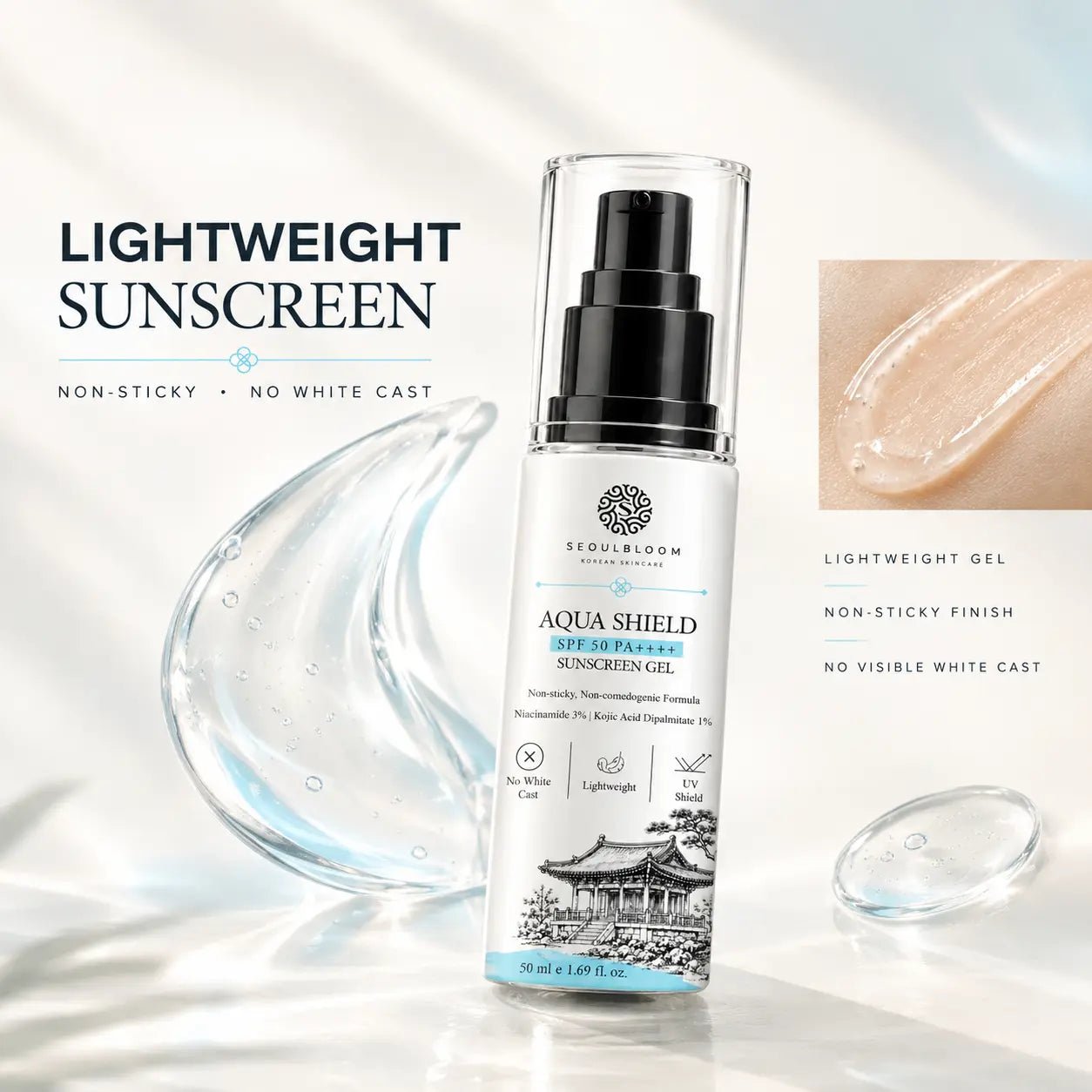
If you want a starting point for humid Indian weather, a lightweight gel with high SPF and PA is an easy daily choice.
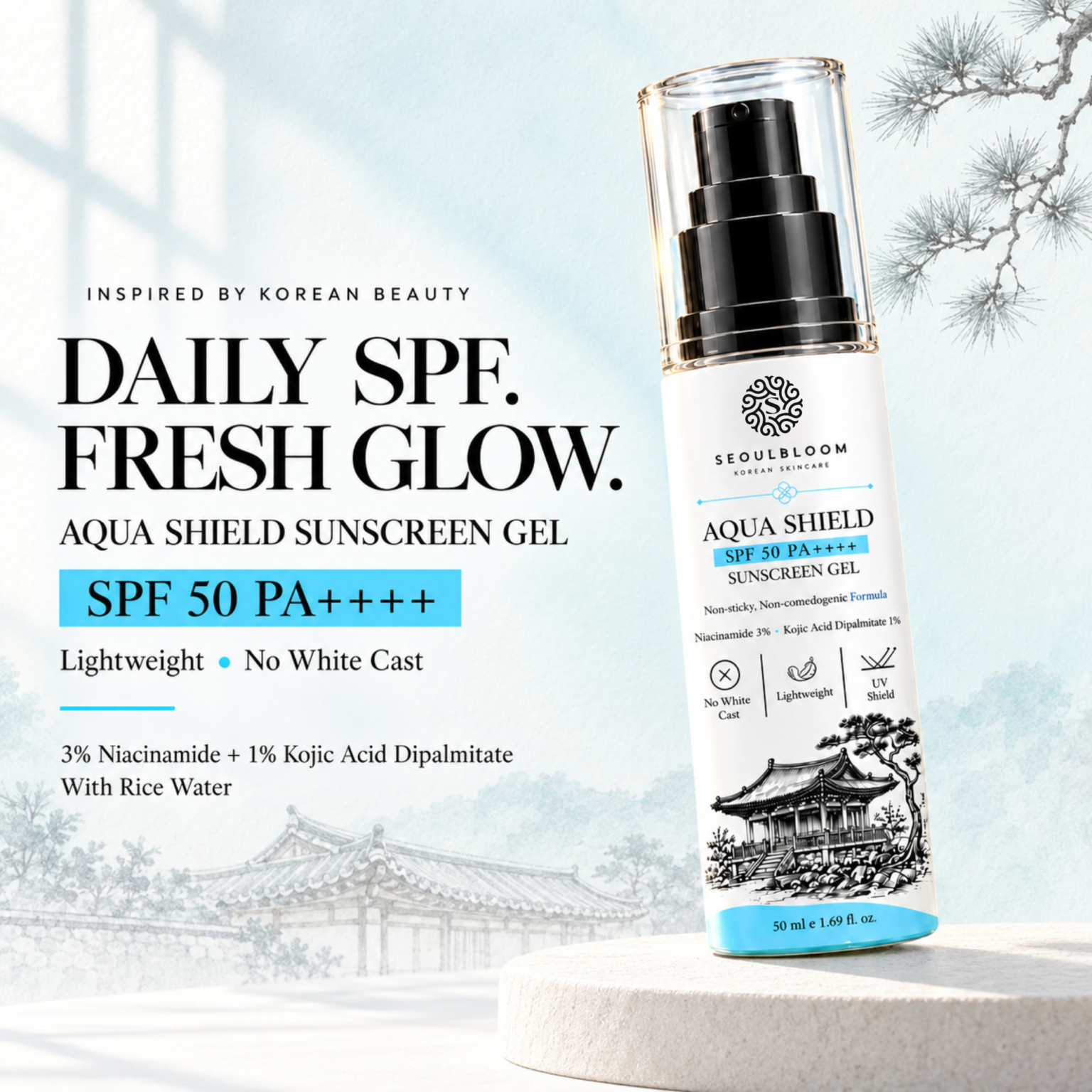
Our pick
SeoulBloom Aqua Shield SPF 50 PA++++ Sunscreen Gel
- SPF 50 PA++++ broad-spectrum UVA/UVB protection
- Lightweight, non-sticky gel — no white cast
- Non-comedogenic; suits oily & combination skin
- 3% niacinamide + 1% kojic acid dipalmitate for even-looking tone
- 60 ml · ₹799
₹999
You can also browse a wider range of SeoulBloom sunscreens by texture. Above all, choose the one you will happily wear every morning.
What are the most common sunscreen myths?
The most common sunscreen myths are that brown skin does not need it, that cloudy days are safe and that one morning coat lasts all day. None of these hold up.
- “Indian skin does not need SPF.” Melanin helps, but it does not stop tanning, pigmentation or ageing. Skin cancer can still occur.
- “I am indoors, so I am safe.” UVA passes through many windows. Besides, short trips outside add up.
- “Cloudy or winter days are fine.” UV still reaches the ground through cloud, as MD Anderson points out.
- “SPF in makeup is enough.” You would need far more foundation than anyone wears to reach the label SPF.
- “Higher SPF means I can stay out longer.” WHO says sunscreen should not be used to extend time in the sun.
Is sunscreen enough on its own?
No, sunscreen works best as one layer in a wider sun-safety plan. WHO and the FDA both recommend shade, clothing, hats and UV-blocking sunglasses alongside it.
In practice, plan errands for early morning or evening during Indian summers. The FDA notes the sun is most intense between 10 a.m. and 2 p.m. Additionally, wear a cap or carry an umbrella, and choose wraparound sunglasses. Together, these habits cover the gaps that any cream leaves behind.
Finally, keep learning the basics. Our sunscreen topics hub links every guide, from ingredients to skin types, so you can build a routine that fits your life.
Frequently asked questions
What is sunscreen made of?
Sunscreen contains active UV filters, such as zinc oxide or avobenzone, plus a base of water, emollients, thickeners and preservatives. The filters protect you, while the base controls texture and finish.
Is sunscreen the same as sunblock?
Mostly, yes. People often say sunblock for mineral formulas. However, no product blocks all UV, so the FDA stopped allowing the term on US labels in 2011.
Which SPF is best for Indian skin?
SPF 30 or higher suits daily use, with PA+++ or PA++++ for UVA. Choose SPF 50 for long outdoor days, travel or beach trips.
Should I apply sunscreen indoors?
If you sit near windows or step out often, yes. UVA can pass through many windows, and short trips outside add up over a day.
When should I apply sunscreen in my routine?
Apply it as the last skincare step in the morning, after moisturiser and before makeup. Ideally, put it on about 30 minutes before you go out.
Does sunscreen expire?
Yes. Check the printed expiry date. According to the FDA, a product without a date should be treated as expired three years after purchase.
Can I use sunscreen on my baby?
The FDA does not recommend sunscreen for babies under six months. Keep infants in shade and covered clothing, and ask your paediatrician what to use as they grow.
How we researched this guide: We reviewed the top-ranking pages for this query, including explainers from Live Science, MD Anderson and Cleveland Clinic and several Indian brand blogs, and found most skipped PA ratings, application amount and Indian context. We then checked every claim against the AAD, WHO, FDA, NHS and Skin Cancer Foundation pages listed below. Read our editorial policy.
Sources & further reading
- AAD: How to decode a sunscreen label
- Skin Cancer Foundation: Sunscreen & your skin
- WHO: Ultraviolet radiation fact sheet
- FDA: Sunscreen – how to help protect your skin from the sun
- NHS: Sunscreen and sun safety
- MD Anderson: How does sunscreen work?
- Wikipedia: Sunscreen
- Live Science: How does sunscreen work?

Written & fact-checked by
SeoulBloom Editorial Team — the skincare research and product team behind SeoulBloom. We formulate and sell sunscreen for Indian skin, test textures in Indian heat and humidity, and check every claim against dermatology bodies (AAD, WHO) and peer-reviewed research. Updated 23 November 2026. How we write & review.
Disclosure: SunscreenGel.com is run by the team behind SeoulBloom, and we link to SeoulBloom products where they fit. This article is for general education, not medical advice — see a dermatologist for skin conditions. Read our disclaimer. Last reviewed November 2026.