Quick answer: A gel sunscreen for oily skin works best when it is water-based, non-comedogenic, broad-spectrum SPF 30 or higher (SPF 50 PA++++ for Indian sun) and free of heavy oils. Apply about one teaspoon to the face in two thin layers, let it set, and reapply every two hours.
Key takeaways
- The AAD says gels are good for oily complexions, but “gel” describes texture, not protection.
- Choose broad-spectrum SPF 30 or higher; SPF 50 with PA++++ suits most Indian cities.
- Check the first five ingredients: water, humectants and UV filters are good signs; heavy oils are not.
- Run a five-day home test for shine, pilling and breakouts before you commit.
- Use about one teaspoon for the face in two thin layers, and reapply every two hours.
Finding a gel sunscreen for oily skin that stays comfortable through an Indian afternoon can feel like guesswork. Many tubes promise a matte finish, yet your forehead still shines by lunch.
This guide takes a practical route. First, we decode the labels. Then we show you how to read the ingredient list, test a formula at home, apply it without pilling and adjust it for monsoon, summer and winter. If you want the full background on the base itself, our guide to sunscreen by skin type is a good next stop.
In this article
- Is gel sunscreen good for oily skin?
- Why does oily skin turn shiny under sunscreen?
- What do the labels on a gel sunscreen for oily skin actually mean?
- Which SPF and PA rating should you pick?
- How do you read the ingredient list of a gel sunscreen for oily skin?
- How to test a gel sunscreen on oily skin at home
- How to apply gel sunscreen on oily skin without pilling
- How do you reapply over makeup and sweat?
- Which gel sunscreen suits oily skin in each Indian setting?
- Can oily, acne-prone skin use gel sunscreen with actives?
- When is a gel sunscreen the wrong choice for oily skin?
- Where does SeoulBloom Aqua Shield fit?
- What are the most common gel sunscreen mistakes?
- FAQ
Is gel sunscreen good for oily skin?
Yes. A gel sunscreen is often the easiest match for oily skin because it has a water-based, light texture with little or no heavy oil. The American Academy of Dermatology (AAD) says gels are good for oily complexions.
However, “gel” describes the texture, not the protection. A gel can still be greasy, sticky or poorly protective. So you still need to check the SPF, the PA grade and the ingredient list. Our complete gel sunscreen guide explains the base itself. This article goes one step further. It shows how to pick, test and wear a gel sunscreen for oily skin through a real Indian day.
Why does oily skin turn shiny under sunscreen?
Oily skin shines because your glands make more sebum than average. A review in the Journal of Clinical and Aesthetic Dermatology notes that sebum output rises in spring, in summer and in humid climates. That explains why a Chennai or Mumbai afternoon feels so oily.
Sunscreen adds a second layer on top of that sebum. If the base is rich, the two films mix and the face looks wet. Sweat makes it worse, because water and oil sit together on the T-zone. In addition, many people rub in extra product to fix a patchy layer, which adds more shine.
The fix is not to skip sunscreen. Instead, choose a lighter base, apply it in thin layers and manage oil through the day. The rest of this guide shows exactly how.
What do the labels on a gel sunscreen for oily skin actually mean?
Most label words describe feel, not science. Brands use them freely, so treat them as hints and then check the finish yourself. The table below decodes the common terms you will see in Indian shops and online.
| Label term | What it usually means | Verdict for oily skin |
|---|---|---|
| Water gel / aqua gel | Very watery base that turns clear quickly | Often the best fit; check that it does not feel sticky |
| Gel | Clear or translucent base with light thickeners | Usually good; test the finish after two hours |
| Gel-cream | Gel base with a little more emollient | Good for oily but dehydrated skin, or winter |
| Matte gel / oil control | Gel with oil-absorbing powders such as silica | Helpful for a very oily T-zone; may feel dry on cheeks |
| Cooling gel | Often contains alcohol or menthol-type ingredients | Feels fresh but can sting; patch-test first |
| Non-comedogenic | Brand says it is made not to clog pores | Look for it, as the AAD advises for acne-prone skin |
Notably, none of these words is a guarantee. Two “matte gels” can behave very differently on the same face. That is why the home test later in this guide matters. In short, read the label for clues, then let your own skin decide. A formula that looks perfect on paper can still feel heavy on your nose by 3 pm, while a plain “gel” might sit beautifully all day.
Which SPF and PA rating should you pick?
Pick at least SPF 30 with a broad-spectrum claim, and PA+++ or PA++++ for Indian sun. The AAD recommends SPF 30 or higher, broad-spectrum and water-resistant formulas in its guide to choosing the right sunscreen.
SPF measures protection from UVB, the rays behind sunburn. According to the AAD, SPF 30 blocks about 97% of UVB rays. PA measures UVA protection, the rays linked to tanning, dark spots and ageing. The PA grade comes from the PPD (persistent pigment darkening) test, so a higher grade means stronger UVA defence.
- PA+: PPD 2 to 4 (low UVA protection)
- PA++: PPD 4 to 8 (moderate)
- PA+++: PPD 8 or more (high)
- PA++++: PPD 16 or more (very high)
For most Indian cities, SPF 50 with PA++++ is a sensible daily choice, especially if you tan or get dark marks after acne. However, the number only works if you apply enough, which oily skin often skips.
How do you read the ingredient list of a gel sunscreen for oily skin?
Start with the first five ingredients, because they make up most of the formula. In a good gel sunscreen for oily skin, you will usually see water, a humectant such as glycerin, and the UV filters near the top. Heavy plant oils and butters high up the list are a warning sign.
Ingredients that tend to help
- Niacinamide: a form of vitamin B3. In one placebo-controlled study of 100 people, 2% topical niacinamide lowered sebum excretion after two and four weeks.
- Silica and similar powders: they absorb surface oil and soften shine.
- Glycerin and hyaluronic acid: they hydrate without adding grease, which matters if you skip a moisturiser.
- Zinc oxide: a mineral UVA and UVB filter. It can help with broad coverage, although some formulas leave a light cast on deeper skin tones.
Ingredients to question
- Alcohol (alcohol denat.) near the top: it helps a gel set quickly. Still, it can sting or dry some skins. The AAD’s acne care tips suggest gentle, alcohol-free products for acne-prone skin.
- Fragrance: fine for many people, but a common trigger for sensitive skin.
- Rich oils and waxes: coconut oil, shea butter and similar ingredients can feel heavy in humidity.
For a wider view of filters and actives, browse the ingredients glossary on our topics hub.
How to test a gel sunscreen on oily skin at home
Run a simple five-day test before you commit to a full tube. First, patch-test a small amount on your jaw for two days. Then wear the gel sunscreen on oily skin for a normal workday and note what happens at each checkpoint below.
| Checkpoint | What to check | Pass sign | Red flag |
|---|---|---|---|
| Right after applying | Feel and cast in daylight | Clear, no white or grey tint | Visible cast or tackiness |
| After 15 minutes | Dry-down and pilling | Sets to a soft, even film | Rolls into flakes when touched |
| After 2 hours | Shine on the T-zone | Mild glow, no oily patches | Forehead looks wet |
| After 5 hours | Oil, sweat and makeup | Blotting paper picks up a little oil | Makeup slides or separates |
| Days 3 to 5 | New bumps or redness | No new breakouts | Small bumps or stinging |
Also note the weather. A gel that passes in Bengaluru’s mild winter may fail in Kolkata’s humid June. So repeat the test when the season changes, and stop using anything that stings or causes a rash.
How to apply gel sunscreen on oily skin without pilling
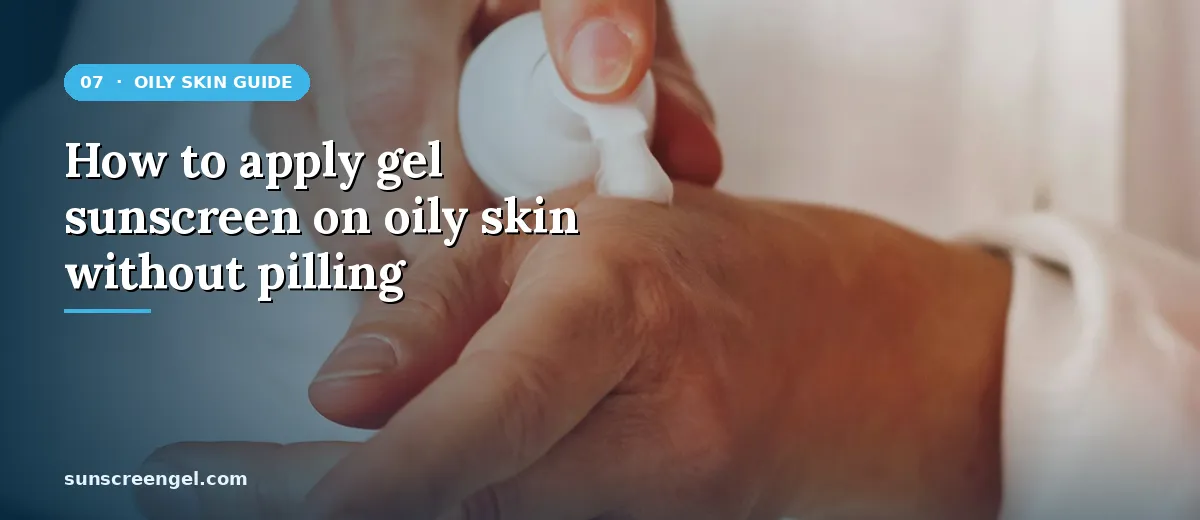
Apply a full dose in two thin layers on clean, lightly hydrated skin, then let it set before makeup. This keeps protection high and shine low.
- Wash with a gentle cleanser and pat your face dry.
- Use a light gel moisturiser only if your skin feels tight. Otherwise, skip it.
- Squeeze out the full amount for your face and neck.
- Dot half on your forehead, cheeks, nose and chin, then press and glide it in.
- Apply the second half the same way, so you cover any gaps.
- Wait about 15 minutes before you go outside or add makeup.
- Press a blotting sheet on the T-zone instead of adding powder straight away.
How much gel sunscreen does oily skin need?
The AAD advises at least one teaspoon for the face, roughly the length of your index and middle fingers. Its application guide also says to reapply every two hours. People with oily skin often use far less, because a full layer feels heavy. That shortcut lowers your real SPF, so use two thin layers rather than one thin smear. Our guide on how much sunscreen to apply on the face shows the amount visually.
How do you reapply over makeup and sweat?
Blot first, then reapply. Pressing a tissue or blotting paper on the face lifts sweat and oil, so fresh sunscreen sits evenly instead of sliding.
Next, warm a little gel between your fingertips and press it over the face. Avoid rubbing, because rubbing moves foundation. If you wear heavy makeup, a sunscreen spray or stick can help top up, but use it generously. Moreover, reapply straight after heavy sweating, swimming or wiping your face with a towel.
Does gel sunscreen for oily skin work under makeup?
Yes, usually better than a cream does. A gel sets to a thin film, so primer and foundation grip it instead of sliding. Still, timing matters. Let the sunscreen dry fully, then apply a thin, oil-free primer only on the T-zone if you need one. Next, use a light foundation or skin tint rather than a heavy base. If your makeup separates by noon, try a mattifying gel or switch to a powder foundation. Also, test any new pairing on a weekend first, because some primers pill over certain gels.
Finally, remember the clouds. The AAD notes that up to 80% of UV rays can pass through clouds. So a grey monsoon day in Pune still needs your second coat.
Which gel sunscreen suits oily skin in each Indian setting?
Match the formula to your day, not just your skin type. Indian weather swings from dry Delhi heat to sticky coastal humidity, and oily skin reacts to both.
| Setting | Best gel style | Extra step |
|---|---|---|
| Humid coast (Mumbai, Chennai, Kochi) | Water gel or matte gel | Carry blotting sheets |
| Monsoon (June to September) | Light gel with a sweat-resistant claim | Reapply after getting wet |
| North Indian summer (May to June) | SPF 50, PA++++ gel | Add a cap and shade at midday |
| Winter in Delhi or Lucknow | Gel-cream | Light moisturiser on dry cheeks |
| Office with air-conditioning | Gel with glycerin or hyaluronic acid | Reapply before the commute home |
| Gym, cricket or two-wheeler rides | Water-resistant gel | Reapply after sweating |
Also check the UV index each morning. The World Health Organization recommends sun protection whenever the UV index reaches 3 or higher. Most weather apps now show the daily UV index for your city, so the check takes seconds.
Can oily, acne-prone skin use gel sunscreen with actives?
Yes, and in many routines it should. Acne treatments and post-acne marks both make daily sun protection more important. Still, layer with care so your skin barrier stays calm.
Gel sunscreen for oily skin with niacinamide
Niacinamide pairs well with most gel sunscreens. You can use a niacinamide serum underneath, or pick a gel sunscreen for oily skin that already contains it. That keeps the routine short, which oily skin usually prefers. Read more in our niacinamide sunscreen guide.
Salicylic acid and retinoids
Use salicylic acid or a retinoid at night when possible. In the morning, keep the routine simple: cleanser, optional light moisturiser, then sunscreen. If your skin stings or peels, pause the active and talk to a dermatologist. Likewise, see a doctor for painful, deep or scarring acne, since sunscreen cannot treat it.
If you want a short routine for clogged pores, SeoulBloom’s acne and pores range groups lightweight options together.
When is a gel sunscreen the wrong choice for oily skin?
A gel sunscreen can be wrong for oily skin when your skin is also dehydrated, irritated or very sensitive. Oily skin can still lack water, especially in winter or with acne treatments.
Watch for these signs. First, your cheeks feel tight while your nose stays oily. Second, the gel stings on application. Third, you see flaking around the nose and mouth. In these cases, a gel-cream or a light lotion often works better. Similarly, people with rosacea may prefer a mineral formula with zinc oxide and titanium dioxide, as the AAD suggests. Our sunscreen for oily skin guide compares these other textures in detail.
Where does SeoulBloom Aqua Shield fit?
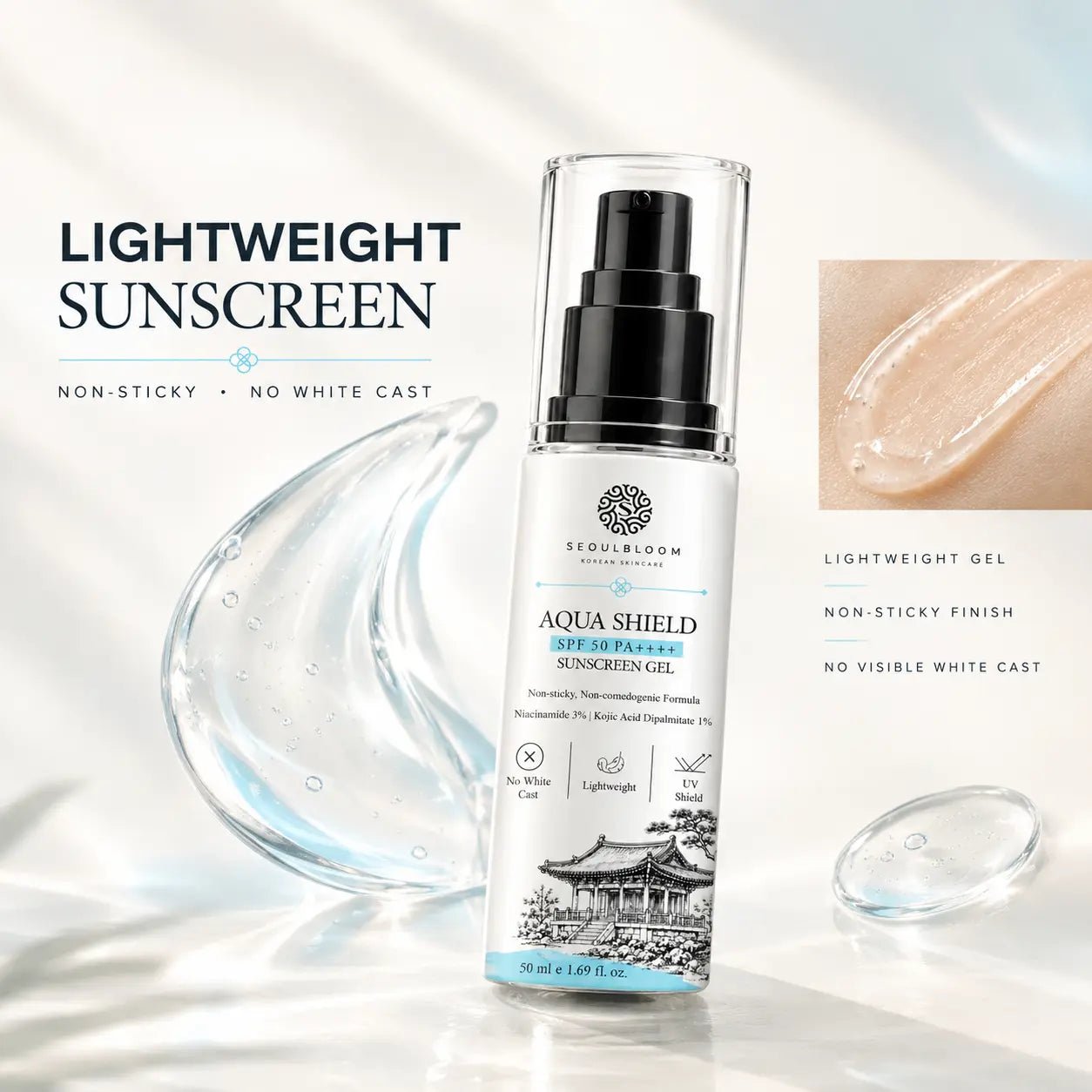
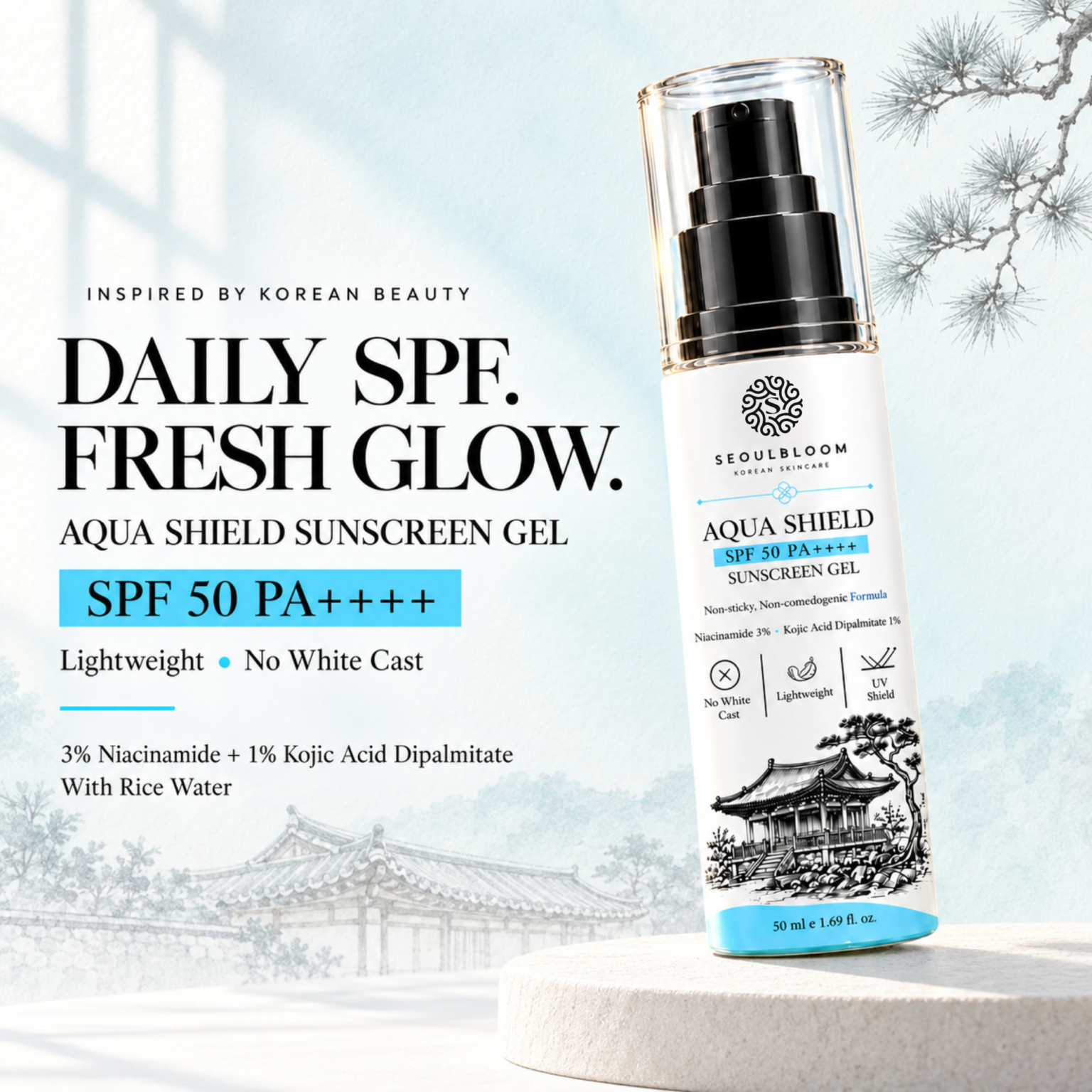
We make a gel-style sunscreen, so here is an honest summary. SeoulBloom Aqua Shield SPF 50 PA++++ costs ₹799 for 60 ml. It is a lightweight, non-sticky formula with 3% niacinamide and 1% kojic acid dipalmitate. The brand labels it non-comedogenic with no white cast, and it suits oily and combination skin.
However, it does not claim water resistance, so reapply after sweating or swimming. It also lists fragrance, so patch-test first if your skin is sensitive. It may not suit everyone, and that is fine.
Our pick
SeoulBloom Aqua Shield SPF 50 PA++++ Sunscreen Gel
- SPF 50 PA++++ broad-spectrum UVA/UVB protection
- Lightweight, non-sticky gel — no white cast
- Non-comedogenic; suits oily & combination skin
- 3% niacinamide + 1% kojic acid dipalmitate for even-looking tone
- 60 ml · ₹799
₹999
What are the most common gel sunscreen mistakes?
The biggest mistake is using too little. A thin smear looks good but protects far less than the label promises. Other common slips include:
- Applying over a heavy moisturiser, which causes pilling and shine.
- Rubbing hard instead of pressing, which leaves gaps.
- Skipping the neck, ears and hairline.
- Adding powder on top of a wet layer.
- Using an old tube. The AAD says sunscreen should keep its strength for three years, but discard it if the colour or texture changes.
Fix these, and most “my sunscreen makes me oily” problems shrink. For more help, explore every guide on the sunscreen topics hub.
Frequently asked questions
Is gel sunscreen good for oily skin?
Yes. The AAD says gels are good for oily complexions because they feel light and leave little residue. Still, check for broad-spectrum SPF 30 or higher and a non-comedogenic label.
Which SPF is best in a gel sunscreen for oily skin in India?
SPF 30 is the AAD minimum. For strong Indian sun, many people prefer SPF 50 with PA++++, especially if they tan easily or get dark marks after acne.
Can a gel sunscreen cause pimples?
It can if the formula clogs your pores or irritates your skin. Choose a non-comedogenic gel, patch-test it, and stop if you notice new bumps after a few days.
Do I need a moisturiser under a gel sunscreen?
Not always. If your skin feels comfortable, the gel alone may be enough. If your cheeks feel tight, add a light gel moisturiser and let it absorb first.
How often should I reapply gel sunscreen on oily skin?
Reapply every two hours outdoors, and straight after sweating, swimming or towel-drying. Blot oil first so the new layer spreads evenly.
Why does my gel sunscreen pill?
Pilling usually happens when you layer it over a heavy cream, rub too hard or add makeup before it sets. Use thinner layers and wait about 15 minutes.
Is a mineral gel sunscreen better for oily skin?
Not necessarily. Mineral filters such as zinc oxide suit sensitive skin, but they can leave a cast on deeper skin. Pick the formula you will wear daily.
How we researched this guide: We reviewed the top Indian search results for this keyword, including guides from Pinkvilla, Smytten, Nykaa and Deconstruct, plus Healthline’s oily-skin guide, and noted their gaps (no tables, few sources, little on testing or application). We then checked every medical claim against AAD, WHO and peer-reviewed sources. Read our editorial policy.
Sources & further reading
- AAD: Sunscreen FAQs
- AAD: How do I know if I’m using the right sunscreen?
- AAD: How to apply sunscreen
- AAD: Acne tips for managing
- WHO: The ultraviolet (UV) index
- Endly & Miller, Oily Skin: A review of treatment options (PMC)
- Wikipedia: Sunscreen (SPF, PA and PPD background)

Written & fact-checked by
SeoulBloom Editorial Team — the skincare research and product team behind SeoulBloom. We formulate and sell sunscreen for Indian skin, test textures in Indian heat and humidity, and check every claim against dermatology bodies (AAD, WHO) and peer-reviewed research. Updated 23 November 2026. How we write & review.
Disclosure: SunscreenGel.com is run by the team behind SeoulBloom, and we link to SeoulBloom products where they fit. This article is for general education, not medical advice — see a dermatologist for skin conditions. Read our disclaimer. Last reviewed November 2026.