Quick answer: A niacinamide sunscreen combines broad-spectrum UV filters with niacinamide (vitamin B3). The filters provide the SPF and PA protection, while 2–5% niacinamide supports an even-looking tone, less shine and a stronger barrier over weeks of daily use. Choose SPF 30–50 with PA+++ or PA++++ in a texture that suits your skin.
Key takeaways
- Niacinamide does not add SPF; the UV filters alone set the SPF and PA rating.
- Studies on 2–5% niacinamide show support for even-looking tone, less sebum and barrier health over 4–12 weeks.
- For Indian sun, pick SPF 30–50 with PA+++ or PA++++ and use two finger-lengths for face and neck.
- Gels and fluids suit oily skin; creams with ceramides suit dry skin.
- Niacinamide layers well with vitamin C, retinoids and moisturisers.
A niacinamide sunscreen promises two things in one step: protection from UVA and UVB rays, plus the skin benefits of vitamin B3. That pitch is popular in India, where tanning, oily skin and uneven tone are everyday worries. But how much does the niacinamide really do?
In this guide, we separate the evidence from the marketing. You will learn what niacinamide can and cannot do, how to read SPF and PA labels, how much niacinamide to look for and how to choose the right texture for your skin type and season.
In this article
- What is a niacinamide sunscreen?
- Does niacinamide add SPF or UV protection?
- What does niacinamide in sunscreen do for your skin?
- What does the research say about niacinamide and UV damage?
- Niacinamide sunscreen vs regular sunscreen: what changes?
- How do you read SPF, PA and PPD on the label?
- Which niacinamide sunscreen suits your skin type?
- How much niacinamide should a sunscreen contain?
- How to apply niacinamide sunscreen correctly
- Can you layer niacinamide sunscreen with other actives?
- Does Indian weather change how you use it?
- Is a niacinamide sunscreen worth it for tanning and dark spots?
- What mistakes stop a niacinamide sunscreen from working?
- Who should be careful with niacinamide?
- FAQ
What is a niacinamide sunscreen?

A niacinamide sunscreen is a broad-spectrum sunscreen that also contains niacinamide, a form of vitamin B3. The UV filters do the protecting. Meanwhile, the niacinamide works as a skincare active in the same layer. So you get sun protection plus a well-studied ingredient in one step.
Most Indian formulas use 2% to 5% niacinamide. Some brands also add vitamin C, rice water, cica or hyaluronic acid. They usually come as gels, fluids or light lotions. That texture suits humid cities like Mumbai, Chennai and Kolkata. If you want the basics of how filters work first, read our guide to SPF and PA ratings.
Does niacinamide add SPF or UV protection?

No. Niacinamide is not a UV filter, so it does not raise the SPF or PA rating. DermNet states clearly that nicotinamide is not a sunscreen and does not prevent sunburn.
Instead, the label rating comes only from the filters. These include zinc oxide, titanium dioxide, avobenzone, octocrylene and newer filters like Tinosorb S. Therefore, judge any bottle by its SPF, PA and broad-spectrum claim first. Treat the niacinamide as a bonus, not as protection.
What does niacinamide in sunscreen do for your skin?

In short, it supports an even-looking tone, less visible oil and a stronger skin barrier. These effects build slowly. Most studies measured changes after four to twelve weeks of steady use.
Even-looking tone and dark spots
A 2002 study in the British Journal of Dermatology found that niacinamide reduced the transfer of pigment packets (melanosomes) to surface skin cells. In addition, a 5% niacinamide moisturiser reduced the look of facial hyperpigmentation after four weeks. Notably, the researchers also tested 2% niacinamide alongside sunscreen in a tanning model. This is why a niacinamide sunscreen makes sense for tanning and dark-spot routines. Still, sunscreen remains the main tool, because UV keeps triggering new pigment.
Oil, shine and pores
According to DermNet, a 2% niacinamide moisturiser reduced facial sebum and shine within four to six weeks. As a result, many brands pair niacinamide with oil-free gel bases. However, niacinamide does not physically shrink pores. It can only make them look less obvious when skin is less oily.
Barrier support and redness
Niacinamide helps skin make more ceramides, the lipids that hold the barrier together. Similarly, DermNet notes that nicotinamide moisturisers improved barrier function in people with rosacea. A calmer barrier can mean less stinging from sweat, pollution and heat.
What does the research say about niacinamide and UV damage?

The evidence is promising, but it mostly comes from oral nicotinamide. A phase 3 trial published in the NEJM gave high-risk Australian adults 500 mg of nicotinamide twice daily for a year. They developed about 23% fewer new non-melanoma skin cancers than the placebo group.
Researchers think nicotinamide helps skin cells keep their energy supply after UV exposure. In turn, this may support DNA repair and reduce UV-related immune suppression. Even so, these results do not prove that a niacinamide sunscreen lowers cancer risk on its own. Put simply, the filters still do the heavy lifting. Never take oral supplements without asking your doctor first.
Niacinamide sunscreen vs regular sunscreen: what changes?

The protection stays the same at the same SPF and PA. What changes is the extra skincare benefit and, often, the texture. Here is a quick side-by-side view.
| Feature | Regular sunscreen | Niacinamide sunscreen |
|---|---|---|
| UVB protection (SPF) | Set by UV filters | Set by UV filters (same) |
| UVA protection (PA / PPD) | Set by UV filters | Set by UV filters (same) |
| Tone support | Indirect, by blocking UV | Blocks UV plus niacinamide support |
| Oil and shine | Depends on the base | Often lighter, with sebum support |
| Barrier support | Depends on the base | Niacinamide helps ceramide production |
| Best for | Anyone who wears it daily | Tanning, uneven tone, oily or combination skin |
So, if a regular sunscreen already suits you, keep using it. On the other hand, a niacinamide sunscreen can simplify a routine if you skip serums on busy mornings.
How do you read SPF, PA and PPD on the label?

SPF measures UVB protection, which relates to sunburn. Meanwhile, PA and PPD measure UVA protection, which relates to tanning, pigmentation and ageing. For Indian sun, look for SPF 30 or higher with PA+++ or PA++++.
| PA rating | PPD value | UVA protection |
|---|---|---|
| PA+ | 2 to 4 | Some |
| PA++ | 4 to 8 | Moderate |
| PA+++ | 8 to 16 | High |
| PA++++ | 16 or more | Very high |
The American Academy of Dermatology recommends a broad-spectrum, water-resistant sunscreen with SPF 30 or higher. Also, SPF 30 blocks roughly 97% of UVB, while SPF 50 blocks about 98%. That small gap matters more when you apply too little. Also look for the words “broad spectrum” on the pack. Some Indian brands now share in-vivo test results too, which adds confidence that the label numbers hold up on real skin. For a deeper look at filters, see our sunscreen ingredients glossary.
Which niacinamide sunscreen suits your skin type?

Choose the base first, then the extras. Niacinamide fits most skin types, but texture decides whether you will wear it daily. Also, check the finish on your own skin tone, because some mineral formulas leave a white cast on medium and deep Indian skin.
| Skin type | Best texture | Look for | Avoid |
|---|---|---|---|
| Oily | Gel or fluid | Non-comedogenic, matte finish | Heavy oils, thick creams |
| Acne-prone | Gel or fluid | Non-comedogenic, fragrance-free | Pore-clogging butters |
| Combination | Gel-cream or fluid | Light hydration, PA++++ | Very drying alcohol bases |
| Dry | Lotion or cream | Ceramides, glycerin, hyaluronic acid | Ultra-matte gels alone |
| Sensitive | Mineral or hybrid | Zinc oxide, low fragrance, 2% to 4% niacinamide | High-strength actives in one product |
For oily and combination skin, a gel sunscreen usually feels best in humid weather. Similarly, if your skin stings easily, read our guide to sunscreen for sensitive skin before you switch.
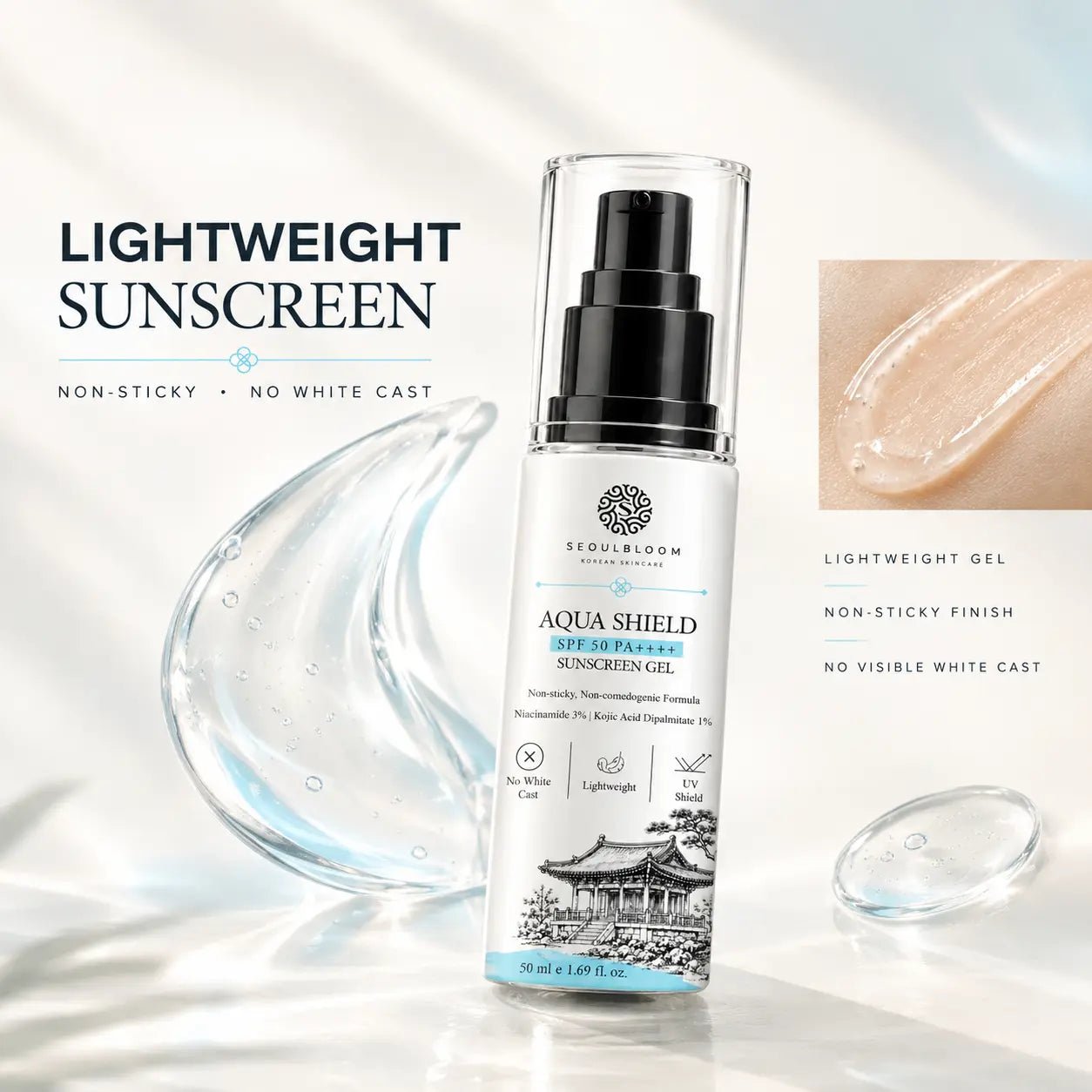
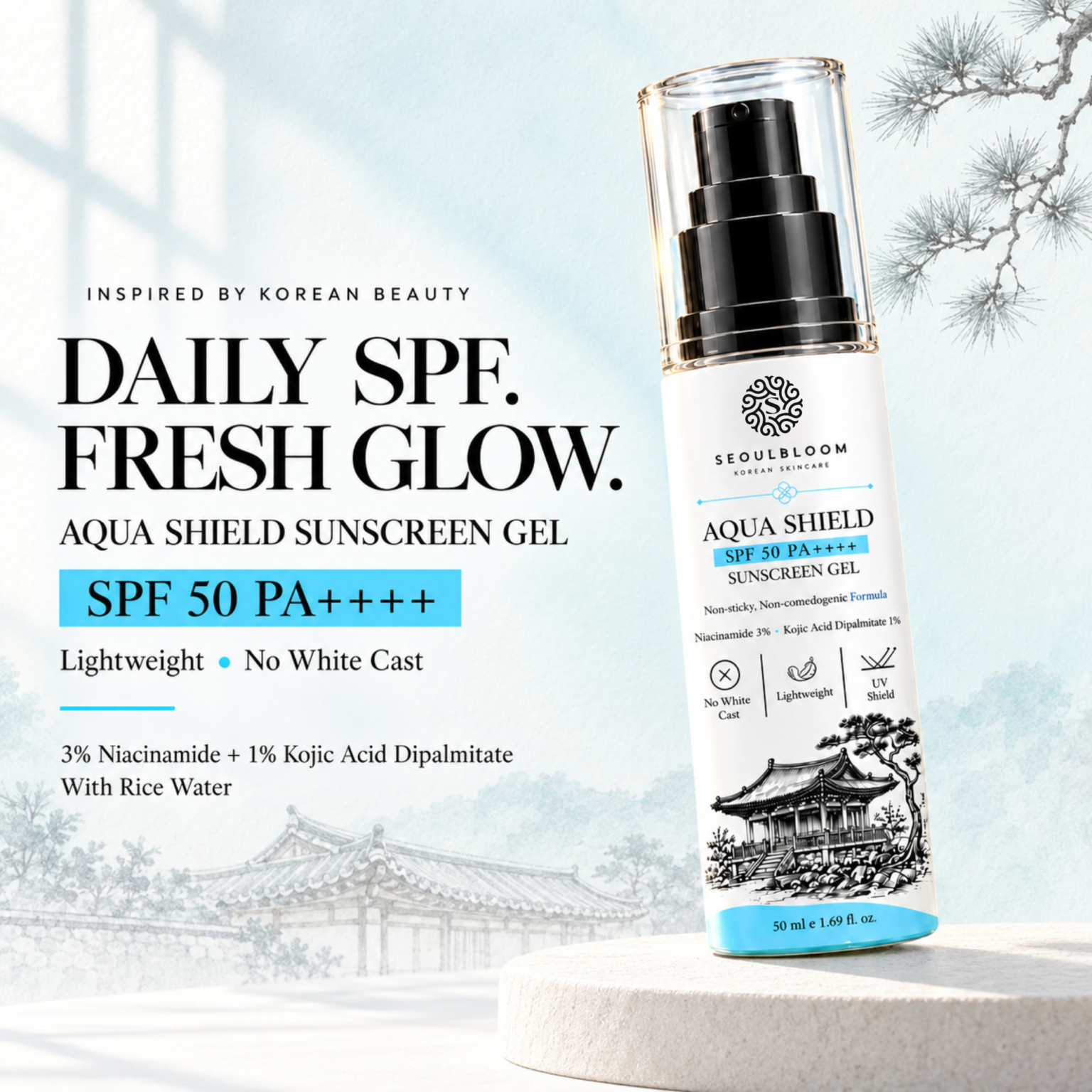
For example, our own Aqua Shield gel pairs SPF 50 PA++++ with 3% niacinamide and 1% kojic acid dipalmitate. It aims at oily and combination skin that wants no white cast. It is one option among many, so match it against the table above.
Our pick
SeoulBloom Aqua Shield SPF 50 PA++++ Sunscreen Gel
- SPF 50 PA++++ broad-spectrum UVA/UVB protection
- Lightweight, non-sticky gel — no white cast
- Non-comedogenic; suits oily & combination skin
- 3% niacinamide + 1% kojic acid dipalmitate for even-looking tone
- 60 ml · ₹799
₹999
How much niacinamide should a sunscreen contain?

Around 2% to 5% is the sweet spot for a niacinamide sunscreen. Most published skin studies used 2% to 5%, and these levels are well tolerated. Higher strengths exist in serums, yet they do not always work better.
In fact, very high levels can cause mild redness or itching in some people. So, if you already use a 10% serum, a sunscreen with 2% to 3% is plenty. Check the ingredient list too. Niacinamide should appear fairly high up, not near the end after fragrance. If a brand states the exact percentage on the pack, that transparency is a good sign. Vague claims like “with the goodness of niacinamide” tell you very little about the real dose.
How to apply niacinamide sunscreen correctly

Apply it as the last step of your morning routine, before makeup. Then reapply every two hours outdoors. Follow these steps.
- First, cleanse and pat your face dry.
- Next, apply a light moisturiser if your skin feels dry. Oily skin can often skip this step.
- Then, squeeze two finger-lengths of sunscreen for your face and neck.
- After that, dot it on the forehead, cheeks, nose, chin and neck, and spread evenly.
- Also, cover the ears, hairline and back of the neck.
- Wait about 15 minutes before you step out, as the AAD advises.
- Finally, reapply every two hours outdoors, and right after sweating or swimming.
The two-finger rule gives roughly the amount used in SPF lab tests. If you use less, you get far less protection than the label says. For more detail, see the how to apply section of our sunscreen guide.
Can you layer niacinamide sunscreen with other actives?

Yes. Niacinamide pairs well with most common actives, so a niacinamide sunscreen rarely causes conflicts. The old warning about niacinamide and vitamin C comes from outdated lab tests. Modern formulas can be used together without trouble.
For instance, a vitamin C serum in the morning works well under sunscreen. Likewise, retinoids and exfoliating acids belong at night, while sunscreen protects skin the next day. If you already use a niacinamide serum, you can still use a niacinamide sunscreen. Just watch for redness, and drop one product if your skin reacts.
Serum or niacinamide sunscreen: do you need both?
Not always. A serum usually holds more niacinamide and sits directly on clean skin. By contrast, a niacinamide sunscreen gives a smaller dose but saves a step. So, if your main goal is tone or oil control, a serum plus any good sunscreen works well. If you prefer a short routine, a niacinamide sunscreen alone is a fair middle ground. Either way, daily sun protection matters more than where the niacinamide comes from.
Does Indian weather change how you use it?
Yes, the season changes texture and reapplication more than the product itself. The WHO advises sun protection whenever the UV Index reaches 3 or above. In much of India, that happens on most days of the year.
Summer (March to June)
UV is at its strongest in cities like Delhi, Ahmedabad and Hyderabad. So, choose SPF 50 PA++++, seek shade around midday, and reapply often. Also, a gel texture helps with sweat.
Monsoon (June to September)
Clouds cut some UV, but not all of it. Therefore, keep wearing sunscreen on grey days. Plus, a non-comedogenic gel helps when humidity makes skin feel greasy.
Winter (November to February)
North Indian winters dry skin out. In that case, layer a moisturiser under your sunscreen. Meanwhile, sunny southern cities still need daily SPF. Check daily levels on our sunscreen topics hub.
Is a niacinamide sunscreen worth it for tanning and dark spots?
It can be, as long as your expectations stay realistic. Sunscreen prevents new tanning and new spots. Then niacinamide adds gentle support for tone over time. Together, they make a sensible daily base for most people.
However, existing marks fade slowly. Post-acne marks often take weeks to months, even with good care. Melasma is harder still, because heat and visible light can also darken it. So, if you have melasma, a tinted mineral sunscreen with iron oxides may help more. Ask a dermatologist which option suits you.
In practice, the best niacinamide sunscreen is the one you enjoy wearing every single day. A formula that feels sticky ends up in a drawer. That is why texture, finish and white cast matter as much as the ingredient list.
What mistakes stop a niacinamide sunscreen from working?
The biggest mistake is using too little. Most people apply a quarter to half of the tested amount, which cuts real protection sharply. Here are other common slips to avoid.
- Skipping reapplication: sweat, towels and touching your face remove sunscreen. So, reapply every two hours outdoors.
- Relying on makeup SPF: foundation and compact give far less protection than a proper layer of sunscreen.
- Missing spots: people often forget the ears, neck, eyelids and hairline.
- Skipping indoor days: UVA passes through window glass, so wear it if you sit near a window.
- Expecting instant results: niacinamide needs weeks, while UV damage starts in minutes.
Above all, pair sunscreen with shade, hats and sunglasses. The WHO calls shade and clothing the best protection, with sunscreen covering the skin they leave exposed.
Who should be careful with niacinamide?
Most people tolerate niacinamide well. Still, a few groups should take extra care.
- Very reactive skin: patch test on the inner arm or jawline for two to three days first.
- Pregnancy or breastfeeding: topical niacinamide is generally considered low risk, but ask your doctor before you change products.
- Children: ask a paediatrician which sunscreen suits your child, and keep babies under six months out of direct sun.
- Melasma or severe acne: see a dermatologist, because these conditions often need prescription care.
Finally, remember that no cosmetic sunscreen treats a skin condition. A niacinamide sunscreen supports skin, but consistent daily use is what matters most. If you want to explore more niacinamide options, browse this niacinamide skincare range.
Frequently asked questions
Is niacinamide sunscreen good for daily use?
Yes. A niacinamide sunscreen is suitable for daily use on most skin types. Apply it every morning and reapply every two hours outdoors. Patch test first if your skin is very reactive.
Does niacinamide sunscreen remove tan?
No sunscreen removes an existing tan. However, daily broad-spectrum protection stops new tanning, and niacinamide supports a more even-looking tone over several weeks. Your natural tan fades as skin renews.
Can I use niacinamide sunscreen on acne-prone skin?
Usually, yes. Choose a non-comedogenic gel or fluid without heavy oils. Niacinamide is well tolerated by acne-prone skin, but see a dermatologist for moderate or severe acne.
Is SPF 50 better than SPF 30 in a niacinamide sunscreen?
SPF 50 blocks slightly more UVB than SPF 30. In strong Indian summer sun, SPF 50 with PA++++ gives a useful buffer, especially because most people apply less than the tested amount.
Can I use a niacinamide serum and a niacinamide sunscreen together?
Yes, most people can. Combined levels from a serum and sunscreen are generally well tolerated. If you notice redness or itching, use only one niacinamide product for a while.
Does niacinamide make skin sensitive to the sun?
No. Unlike retinoids or some acids, niacinamide does not increase sun sensitivity. Even so, you still need daily sunscreen for UV protection.
Can men use niacinamide sunscreen?
Yes. Niacinamide sunscreen works the same way for every skin. Men with oily skin or beards often prefer a light gel or fluid that absorbs fast and does not feel greasy after shaving.
Is niacinamide sunscreen safe during pregnancy?
Topical niacinamide is generally considered low risk. Still, ask your doctor before changing products during pregnancy or breastfeeding, especially if the formula has other actives.
How we researched this guide: We reviewed the top-ranking Indian pages for “niacinamide sunscreen” and checked every claim against the American Academy of Dermatology, the WHO, DermNet and peer-reviewed studies on PubMed. Where evidence comes from oral nicotinamide rather than topical use, we say so. Read our editorial policy.
Sources & further reading
- American Academy of Dermatology: How to apply sunscreen
- WHO: Ultraviolet radiation fact sheet
- DermNet: Nicotinamide
- Hakozaki et al. (2002): The effect of niacinamide on reducing cutaneous pigmentation and suppression of melanosome transfer, British Journal of Dermatology
- Chen et al. (2015): A Phase 3 Randomized Trial of Nicotinamide for Skin-Cancer Chemoprevention, NEJM
- Nicotinamide for photoprotection and skin cancer chemoprevention: a review (PubMed)

Written & fact-checked by
SeoulBloom Editorial Team — the skincare research and product team behind SeoulBloom. We formulate and sell sunscreen for Indian skin, test textures in Indian heat and humidity, and check every claim against dermatology bodies (AAD, WHO) and peer-reviewed research. Updated 20 November 2026. How we write & review.
Disclosure: SunscreenGel.com is run by the team behind SeoulBloom, and we link to SeoulBloom products where they fit. This article is for general education, not medical advice — see a dermatologist for skin conditions. Read our disclaimer. Last reviewed November 2026.