Quick answer: A sunscreen gel SPF 50 is a light, water-based sunscreen that filters about 98% of UVB. Pick one labelled PA++++ or broad spectrum, and non-comedogenic for oily skin. Apply a quarter to a third of a teaspoon on the face, and reapply every two hours outdoors.
Key takeaways
- SPF 50 filters about 98% of UVB, versus about 97% for SPF 30, so the gain is small but real.
- SPF covers UVB only; look for PA++++ or broad spectrum for UVA cover against tanning and dark spots.
- Gels suit oily, combination and acne-prone skin, and hairy areas such as beards.
- Use about a quarter to a third of a teaspoon for the face; a thin layer gives far less than SPF 50.
- Reapply every two hours outdoors, whatever the SPF number.
A sunscreen gel SPF 50 promises two things Indian buyers want: strong protection and a texture that does not melt into a greasy film by noon. But what does the 50 really add over SPF 30, and does every gel deliver it?
In this guide, we break down the numbers on the label, including SPF, PA++++ and water resistance. Next, we show who in India benefits most from SPF 50, how to match a gel to your skin type, and exactly how much to apply. Every claim links back to dermatology bodies such as the AAD, the Skin Cancer Foundation, the NHS and WHO.
In this article
- What is a sunscreen gel SPF 50?
- How much more does SPF 50 protect than SPF 30?
- What does PA++++ mean on an SPF 50 sunscreen gel?
- Who in India needs a sunscreen gel with SPF 50?
- Is an SPF 50 gel sunscreen good for oily and acne-prone skin?
- How to choose the best sunscreen gel SPF 50: a label checklist
- Chemical, mineral or hybrid filters: which works best in a gel?
- How much SPF 50 sunscreen gel should you apply?
- How to apply and reapply sunscreen gel SPF 50 in Indian weather
- Common mistakes that weaken SPF 50 protection
- Our pick: a light SPF 50 gel for Indian humidity
- Do you need SPF 50 all year in India?
- FAQ
What is a sunscreen gel SPF 50?

A sunscreen gel SPF 50 is a water-based, oil-light sunscreen that carries an SPF of 50 on its label. In simple terms, it pairs a high level of UVB protection with a texture that sinks in fast. As a result, it suits hot, sticky days in cities like Mumbai, Chennai and Kolkata.
The texture and the number do two separate jobs. The gel base decides how the product feels on your skin. Meanwhile, the SPF 50 rating tells you how well it shields you from UVB, the rays behind sunburn. For a deeper look at the gel format itself, read our full guide to gel sunscreen. This article focuses on the SPF 50 side: what the number really buys you, and how to choose one well.
Notably, SPF alone says nothing about UVA. That is why the PA rating and the words “broad spectrum” matter just as much. We cover both below.
How much more does SPF 50 protect than SPF 30?
SPF 50 blocks slightly more UVB than SPF 30, but the gap is small. According to the American Academy of Dermatology (AAD), SPF 15 filters about 93% of UVB and SPF 30 filters about 97%. MD Anderson Cancer Center puts SPF 50 at about 98%.
| SPF on the label | Approx. UVB filtered | Approx. UVB reaching skin | Best use in India |
|---|---|---|---|
| SPF 15 | ~93% | ~7% | Below the AAD minimum; not ideal on its own |
| SPF 30 | ~97% | ~3% | Indoor days, short commutes |
| SPF 50 | ~98% | ~2% | Long outdoor hours, travel, summer, high altitude |
So why bother with 50? Look at the right-hand column. SPF 30 lets roughly 3% of UVB through, while SPF 50 lets roughly 2% through. In other words, a little less UVB reaches your skin. That small gain helps most when you spend long hours outside.
Moreover, most people apply too little sunscreen. A higher number gives you a slightly bigger buffer when your layer is thin. However, it never replaces a proper amount. The Skin Cancer Foundation recommends SPF 30 or higher for daily use. For extended outdoor activity, it advises a water-resistant, broad-spectrum SPF 50 or higher.
One more point: SPF is not a time allowance. An SPF 50 gel does not let you stay out longer than SPF 30 without reapplying. Both need a fresh layer every two hours outdoors.
What does PA++++ mean on an SPF 50 sunscreen gel?
PA++++ means the SPF 50 sunscreen gel offers the highest grade of UVA protection on the PA scale. While SPF tracks UVB, PA tracks UVA, the rays linked to tanning, dark spots and skin ageing.
The PA system comes from Japan and is popular with Korean and Indian brands. It rests on a test called PPD, or persistent pigment darkening. Instead of measuring redness, PPD measures how much UVA it takes to darken skin. According to Wikipedia’s overview of sunscreen, the PA grades map to PPD values like this:
| PA grade | UVA protection factor (PPD) | What it means for you |
|---|---|---|
| PA+ | about 2 to 4 | Some UVA protection |
| PA++ | about 4 to 8 | Moderate UVA protection |
| PA+++ | more than 8 | High UVA protection |
| PA++++ | 16 or above (grade added in 2013) | Highest grade on the scale |
For Indian skin, UVA matters a great deal. Indeed, tanning and uneven tone are among the most common sun concerns here. Therefore, look for “SPF 50 PA++++” or “SPF 50 broad spectrum” together, not SPF alone. You can learn more in the SPF and PA section of our sunscreen guide.
Who in India needs a sunscreen gel with SPF 50?
You will benefit most from a sunscreen gel with SPF 50 if you spend long stretches outdoors or live with strong, humid heat. For short indoor days, a good SPF 30 is enough for most people.
Consider SPF 50 if any of these sound like you:
- You commute by bike, auto or on foot for an hour or more.
- Your work keeps you outdoors, such as field sales, delivery, sport or site visits.
- You plan a beach trip to Goa, a hill trek in Himachal or a day at a cricket ground.
- You get tanned or develop dark spots easily.
- Your dermatologist has advised strict sun protection.
Timing matters too. The World Health Organization notes that UV peaks in the four hours around solar noon. It also advises sun protection once the UV index reaches 3 or higher. In April, May and June, midday sun across north and central India is fierce. Similarly, coastal cities stay humid for much of the year. A light gel makes daily SPF 50 far easier to stick with in these conditions.
Is an SPF 50 gel sunscreen good for oily and acne-prone skin?
Yes, an SPF 50 gel sunscreen is usually the most comfortable pick for oily and acne-prone skin. Gels tend to feel lighter and leave less shine than rich creams. Still, the full formula matters more than the word “gel”.
The AAD advises people with acne-prone skin to look for “non-comedogenic” or “won’t clog pores” on the label. It also notes that gels work well on hairy areas, which helps men with beards. For more detail on shine control, see our guide to sunscreen for oily skin.
| Skin type | Does an SPF 50 gel suit it? | What to look for |
|---|---|---|
| Oily | Yes, usually the best fit | Non-comedogenic, matte or “dry-touch” finish, niacinamide |
| Combination | Yes | Lightweight gel; add moisturiser only on dry patches |
| Acne-prone | Often | Non-comedogenic, fragrance-light, patch test first |
| Dry | Sometimes | Gel with glycerin or hyaluronic acid over a moisturiser |
| Sensitive | Depends on the filters | Fragrance-free; mineral filters (zinc oxide, titanium dioxide) |
| Deeper skin tones | Yes | Clear finish with no white cast, or a tinted option |
Dry and sensitive skin need a little more care. A gel can feel tight on very dry skin in a Delhi winter. In that case, layer it over a simple moisturiser. Meanwhile, sensitive skin may react to fragrance or some chemical filters. The AAD suggests avoiding fragrance, parabens and oxybenzone if your skin stings.
How to choose the best sunscreen gel SPF 50: a label checklist
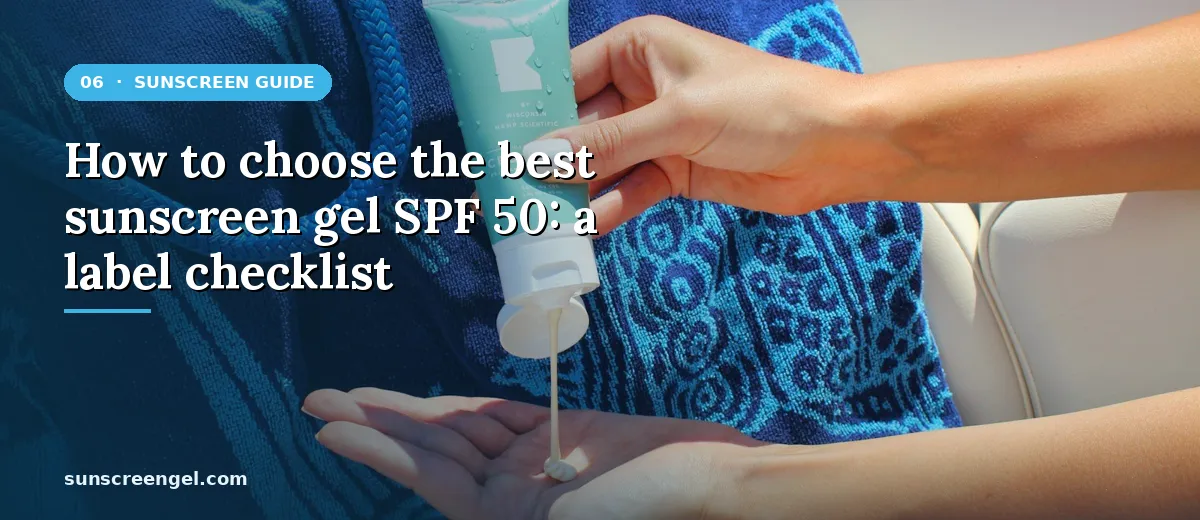
To choose the best sunscreen gel SPF 50, check the label for five things: SPF 50, PA++++ or broad spectrum, a non-comedogenic claim, a filter type that suits your skin, and a texture you will reuse daily. The best sunscreen is the one you actually wear every morning.
- SPF 50 and PA++++. Both numbers should appear. If the pack says “broad spectrum” instead of PA, that also signals UVA cover.
- Non-comedogenic. This matters most for oily and acne-prone skin.
- Water resistance, if you sweat. The AAD explains that “water resistant” lasts 40 minutes and “very water resistant” lasts 80 minutes in water or sweat.
- Finish and cast. Swatch it on your jawline. A clear gel should leave no white or grey film on Indian skin tones.
- Supporting ingredients. Niacinamide can help with oil and the look of uneven tone. Glycerin and aloe add light hydration.
- Size and price per use. You need a generous layer daily, so a tiny tube runs out fast.
Also check the expiry date before you buy. The NHS points to the open-jar symbol, which shows how many months a product lasts once opened.
Chemical, mineral or hybrid filters: which works best in a gel?
Most clear SPF 50 gels use chemical (organic) UV filters, because these blend in without a white cast. Mineral filters, namely zinc oxide and titanium dioxide, sit on the skin and can leave a whitish tint. Hybrid gels combine both types.
Each option has a place. Chemical filters give that clear, invisible finish many Indians prefer. On the other hand, the AAD often points sensitive skin towards mineral filters. If a gel stings around your eyes, try a mineral or hybrid formula instead. Patch testing first is always wise.
Tinted sunscreens add one more benefit. According to the AAD, iron oxides in tinted formulas also block visible light. That can help prevent dark spots and melasma, especially on darker skin. So, if pigmentation is your main worry, a tinted option is worth a look.
How much SPF 50 sunscreen gel should you apply?
For your face, apply about a quarter to a third of a teaspoon of SPF 50 sunscreen gel. That amount comes close to the lab standard of 2 mg per square centimetre. Many people find the two-finger rule an easy guide, which our guide on how much sunscreen to apply on face explains step by step.
This step matters more than the number on the tube. Labs test SPF with a thick, even layer. Yet studies show most people apply only a quarter to half of that amount. Consequently, your real protection can fall well below the SPF 50 printed on the pack.
For the whole body, the target rises sharply. Wikipedia’s sunscreen overview cites about 35 ml, roughly a golf-ball-sized amount, for an average adult. Likewise, the NHS suggests around 6 to 8 teaspoons to cover the body. In short, a light dab simply will not deliver SPF 50.
How to apply and reapply sunscreen gel SPF 50 in Indian weather
Apply your sunscreen gel SPF 50 as the last step of your morning skincare, then reapply every two hours outdoors. Follow these steps for even cover:
- Cleanse, then use a light moisturiser if your skin feels dry.
- Squeeze out a quarter teaspoon, or two finger-lengths, of gel.
- Dot it over your forehead, cheeks, nose, chin and neck.
- Spread it evenly; do not rub it away. Include ears, hairline and the back of the neck.
- Let it set for a few minutes before makeup.
- Reapply every two hours outdoors, and after swimming, heavy sweating or towel drying.
The NHS also suggests applying sunscreen before you head out, then topping up often. In the Chennai or Mumbai monsoon, sweat and drizzle wipe off product faster. Therefore, carry a small tube in your bag.
Reapplying over makeup and at the office
If you work indoors with little window light, one morning layer often covers a desk day. However, reapply before a lunch walk or an evening commute. Over makeup, blot oil first with a tissue. Then pat on a thin layer of gel with clean fingertips or a sponge. An SPF mist or stick can help between full layers, but use enough product to matter.
Common mistakes that weaken SPF 50 protection
The most common mistake is using too little. Other habits also cut into the protection you paid for. Watch out for these:
- Skipping reapplication. SPF 50 still wears off with sweat, touch and time.
- Mixing it with foundation. This dilutes the layer, so apply sunscreen first.
- Missing spots. Ears, eyelids, the neck and the hands often get forgotten.
- Relying on sunscreen alone. The NHS advises shade and clothing as well.
- Using an old tube. Heat in a car or bag can affect a product, so respect the expiry date.
- Trusting makeup SPF. You rarely apply enough foundation to reach its label SPF.
Above all, remember that no sunscreen blocks 100% of UVB, as the AAD points out. A hat, sunglasses and midday shade complete the routine.
Our pick: a light SPF 50 gel for Indian humidity

If you want a clear, lightweight gel for daily use, our own formula is one option worth a look. We make it, so we list its specs plainly and leave the choice to you.
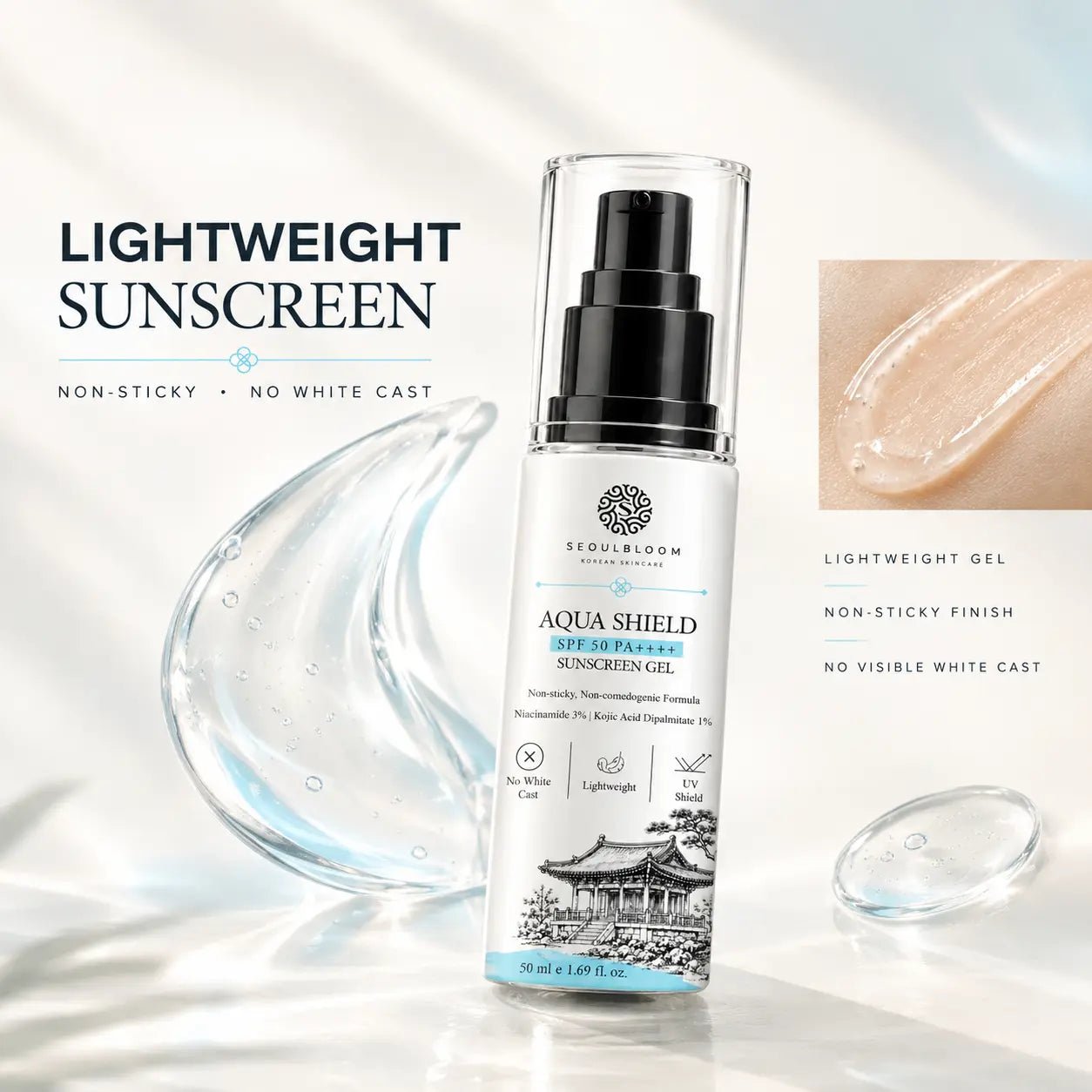
The SeoulBloom Aqua Shield SPF 50 PA++++ gel costs ₹799 for 60 ml. It carries a non-comedogenic, no-white-cast claim, plus 3% niacinamide and 1% kojic acid dipalmitate. It suits oily and combination skin best. To be transparent, it does contain fragrance and the filter oxybenzone (benzophenone-3). So, if your skin is very sensitive, a fragrance-free mineral formula may suit you better.
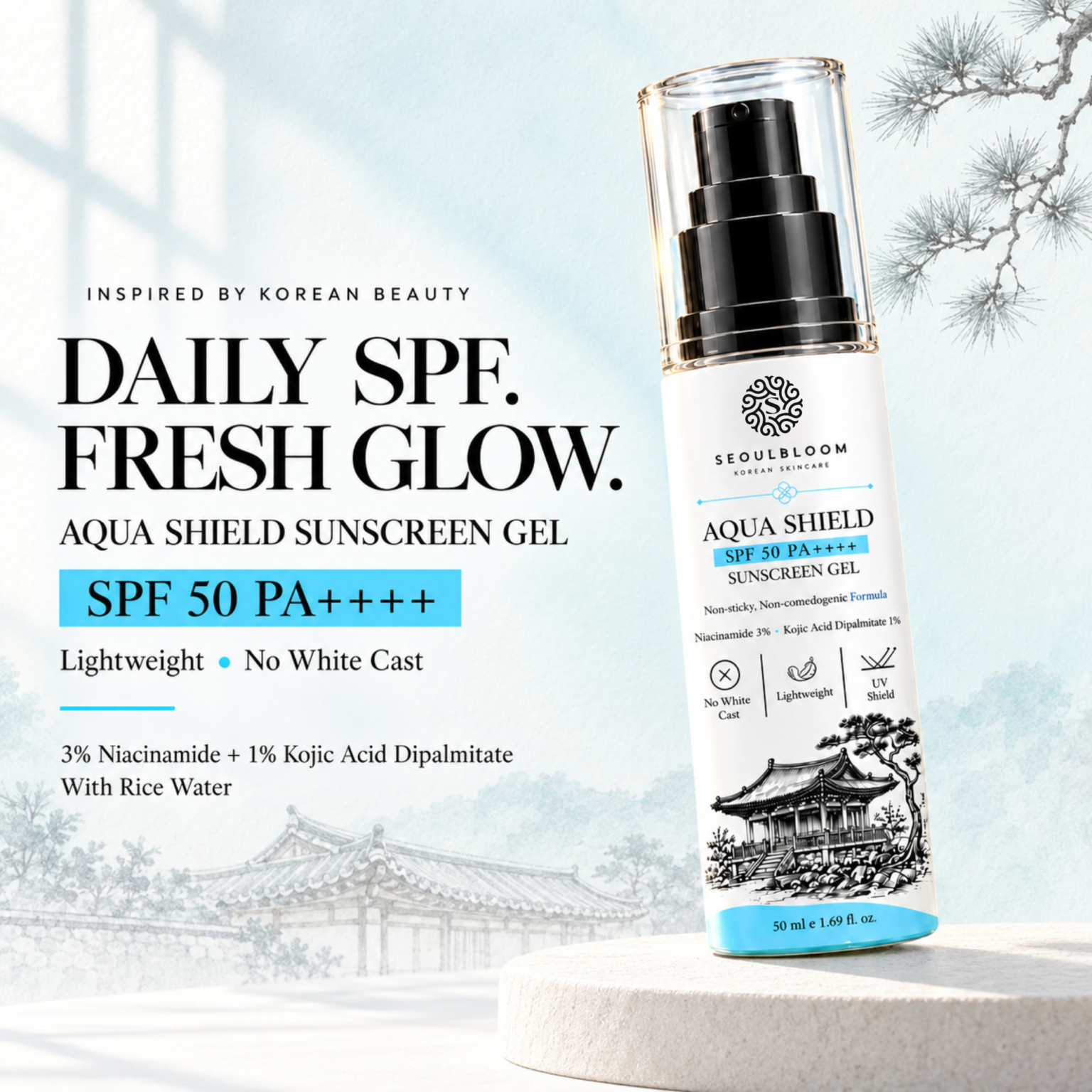
Our pick
SeoulBloom Aqua Shield SPF 50 PA++++ Sunscreen Gel
- SPF 50 PA++++ broad-spectrum UVA/UVB protection
- Lightweight, non-sticky gel — no white cast
- Non-comedogenic; suits oily & combination skin
- 3% niacinamide + 1% kojic acid dipalmitate for even-looking tone
- 60 ml · ₹799
₹999
Whichever brand you choose, run a patch test first. Apply a little behind your ear or on your jaw for a couple of days. If redness or itching appears, stop and see a dermatologist.
Do you need SPF 50 all year in India?
Not always. SPF 50 helps most in summer, on holidays and on long outdoor days. For winter office days in Delhi or Bengaluru, a broad-spectrum SPF 30 is usually enough, as long as you apply it well.
That said, many people prefer one tube all year. If an SPF 50 gel feels comfortable, simply keep using it. Consistency beats switching products every season. For more topics, browse our sunscreen types hub or the full list of sunscreen topics.
Frequently asked questions
Is sunscreen gel SPF 50 better than SPF 30?
SPF 50 blocks about 98% of UVB versus about 97% for SPF 30. The gain is small, but it helps on long outdoor days. For short indoor days, a well-applied SPF 30 is enough for most people.
Can I use SPF 50 gel sunscreen every day?
Yes. Daily use of a broad-spectrum SPF 50 gel is fine for most skin types. Choose one you like wearing, and patch test it first if you have sensitive skin.
Is sunscreen gel SPF 50 good for oily skin?
Usually, yes. Gel textures feel light and leave less shine. Look for a non-comedogenic label and a matte or dry-touch finish.
How often should I reapply SPF 50 gel?
Reapply every two hours when outdoors, and after swimming, heavy sweating or towel drying. A higher SPF does not extend this interval.
Does SPF 50 gel protect against tanning?
It reduces tanning only if it also offers strong UVA protection. So, look for PA++++ or broad spectrum, apply enough, and reapply. Shade and clothing help too.
Can men use a sunscreen gel SPF 50?
Yes. The AAD notes gels work well on hairy areas, so they suit beards. Moreover, the light texture suits men who dislike creamy products.
Is SPF 50 gel sunscreen safe for children?
Ask a paediatrician before using any sunscreen on babies and young children. Kids often do better with fragrance-free mineral formulas, but medical advice comes first.
How we researched this guide: We reviewed the top Indian search results for this keyword, including retailer and media buying guides from Purplle, Pinkvilla, Smytten, LBB and Nykaa, and noted that most skip the PA scale, application amount and sources. We then checked every number against the AAD, Skin Cancer Foundation, MD Anderson, NHS, WHO and the SeoulBloom product page. Read our editorial policy.
Sources & further reading
- AAD: How to select a sunscreen
- AAD: How to decode a sunscreen label
- AAD: How do I know if I’m using the right sunscreen?
- Skin Cancer Foundation: Does a high SPF protect my skin better?
- MD Anderson Cancer Center: What SPF should I use?
- NHS: Sunscreen and sun safety
- WHO: The ultraviolet (UV) index
- Wikipedia: Sunscreen

Written & fact-checked by
SeoulBloom Editorial Team — the skincare research and product team behind SeoulBloom. We formulate and sell sunscreen for Indian skin, test textures in Indian heat and humidity, and check every claim against dermatology bodies (AAD, WHO) and peer-reviewed research. Updated 22 November 2026. How we write & review.
Disclosure: SunscreenGel.com is run by the team behind SeoulBloom, and we link to SeoulBloom products where they fit. This article is for general education, not medical advice — see a dermatologist for skin conditions. Read our disclaimer. Last reviewed November 2026.