Quick answer: Yes, you still need sunscreen in winter in India. Cold weather lowers heat, not UVA, which causes tanning and pigmentation all year. Use broad-spectrum SPF 30 or higher with PA+++ or PA++++ daily, apply it over moisturiser on dry skin, and reapply every two hours outdoors, especially in hills or snow.
Key takeaways
- Delhi logged its coldest morning of the season, 10.5°C, on 20 November 2026, but colder air does not mean less UVA.
- WHO advises sun protection whenever the UV index reaches 3 or above, which many Indian winter middays still cross.
- Fog, smog and clouds are not sun protection; clouds cut UV by only about half.
- Choose broad-spectrum SPF 30+ with PA+++ or PA++++ for the city, and SPF 50 PA++++ for hills and snow.
- Dry skin should layer sunscreen over moisturiser rather than skip it.
Sunscreen in winter feels optional the moment the mercury drops, and this week it dropped fast. On 20 November 2026, Delhi recorded its coldest morning of the season at 10.5°C, with fog and “poor” air quality across the city.
Yet cold air does not cancel UV rays. In this guide, we explain what really changes in the Indian winter, which SPF and PA to choose, and how to layer sunscreen on dry winter skin. Every claim below links to a health body or the original news report.
In this article
- What happened in Delhi this week, and why does it matter for sunscreen in winter?
- Do you really need sunscreen in winter in India?
- How strong is winter UV in Indian cities?
- Summer vs winter sun: what actually changes?
- Does smog or fog block UV rays?
- Which SPF and PA do you need for sunscreen in winter?
- Which sunscreen in winter suits your skin type?
- How do you apply sunscreen in winter the right way?
- Do you need sunscreen in winter indoors or on cloudy days?
- Who needs extra sun protection in winter?
- How do you reapply sunscreen in winter over makeup?
- Winter sunscreen myths vs facts
- What is a good sunscreen in winter for oily and combination skin?
- How else can you protect your skin from winter sun?
- FAQ
What happened in Delhi this week, and why does it matter for sunscreen in winter?
On Friday, 20 November 2026, Delhi recorded its coldest morning of the season so far. According to The Week, Safdarjung and Ayanagar both touched 10.5°C. That was about two degrees below normal. Meanwhile, the overall AQI stood at 267, in the “poor” band.
The IMD also forecast dry weather, chilly mornings and fog for the next several days. For most people, that is the signal to pack sunscreen away. However, the cold changes how the sun feels, not how much UV reaches your skin. That gap is why sunscreen in winter matters so much in India.
In short, a cold morning can still become a bright, high-UV afternoon. So this guide explains what really changes in winter, and what does not.
Do you really need sunscreen in winter in India?

Yes. You need sunscreen in winter because UV radiation does not switch off when the temperature drops. Heat comes from infrared light, whereas sunburn and tanning come from ultraviolet light.
The World Health Organization advises sun protection whenever the UV index reaches 3 or above. Much of India sits close to the Tropic of Cancer. As a result, clear winter middays in many cities can still cross that line. You can track daily readings on our UV index India guide.
There are two types of UV to think about:
- UVB drives sunburn. It dips in winter, yet it does not disappear.
- UVA drives tanning, pigmentation and photo-ageing. The Skin Cancer Foundation notes that UVA stays fairly constant through the year and passes through glass.
For Indian skin, UVA is the bigger story. Melanin-rich skin tans and develops dark spots easily. Therefore, skipping sunscreen in winter can quietly undo months of careful summer protection.
How strong is winter UV in Indian cities?

Winter UV in India depends on your latitude, altitude and the time of day. Overall, the further south you live, the stronger your winter sun tends to be.
North Indian plains: Delhi, Lucknow, Chandigarh, Jaipur
Mornings are foggy and cold right now. Even so, many afternoons clear up and turn sunny. That midday window, roughly 10 am to 4 pm, is when UV peaks. Office commutes, school runs and terrace sunbathing all fall inside it.
South and coastal India: Chennai, Bengaluru, Hyderabad, Mumbai
Here, “winter” mostly means pleasant weather. The sun stays high and strong. In fact, many people spend more time outdoors in these months. So sunscreen in winter is simply sunscreen as usual in these cities.
Hills and snow: Shimla, Manali, Gulmarg, Ladakh
Winter holidays bring the highest risk. NIH’s MedlinePlus Magazine reports that UV rises by roughly 6% for every 1,000 feet of altitude in the Alps. In addition, fresh snow can reflect up to 80% of UV light, according to the Skin Cancer Foundation. That means you get hit twice: once from above and once from below.
Summer vs winter sun: what actually changes?

Only a few things change between seasons. Most of the risk stays the same. This table compares the two for a typical Indian city.
| Factor | Summer (Apr–Jun) | Winter (Nov–Feb) |
|---|---|---|
| Temperature | Hot, often 40°C+ in the north | Cool to cold; fog in the north |
| UVB (burning rays) | Very high | Lower, but present on clear days |
| UVA (tanning, ageing rays) | High | Still significant; passes through glass |
| How the sun feels | Harsh, sweaty | Pleasant, so people stay out longer |
| Skin condition | Oily, sweaty | Dry, tight, weaker barrier |
| Best texture | Light gel | Gel over moisturiser, or a hydrating lotion |
| Reapplication | Every 2 hours outdoors | Every 2 hours outdoors |
Notice the last row. The American Academy of Dermatology gives the same reapplication advice in cold weather: every two hours outdoors, and after sweating.
Does smog or fog block UV rays?
No, not reliably. Fog and smog can make the sky look grey, but they are not sun protection. The WHO notes that UV levels can stay high even under cloud cover.
MedlinePlus adds that clouds cut UV by only about 50%. Similarly, the Skin Cancer Foundation says UVA can penetrate clouds and fog. So a hazy Delhi afternoon still carries UV exposure.
Pollution also adds its own stress. In a 14 November 2026 report by The Open Press, Chennai dermatologist Dr Pushpa Gnanaraj linked winter smog to dry, itchy skin and a weaker barrier. She advised daily SPF 30 or higher during the smog season.
In practice, sunscreen in winter is not a pollution shield on its own. Still, a good routine helps: cleanse gently at night, moisturise, and wear broad-spectrum SPF every morning.
Which SPF and PA do you need for sunscreen in winter?
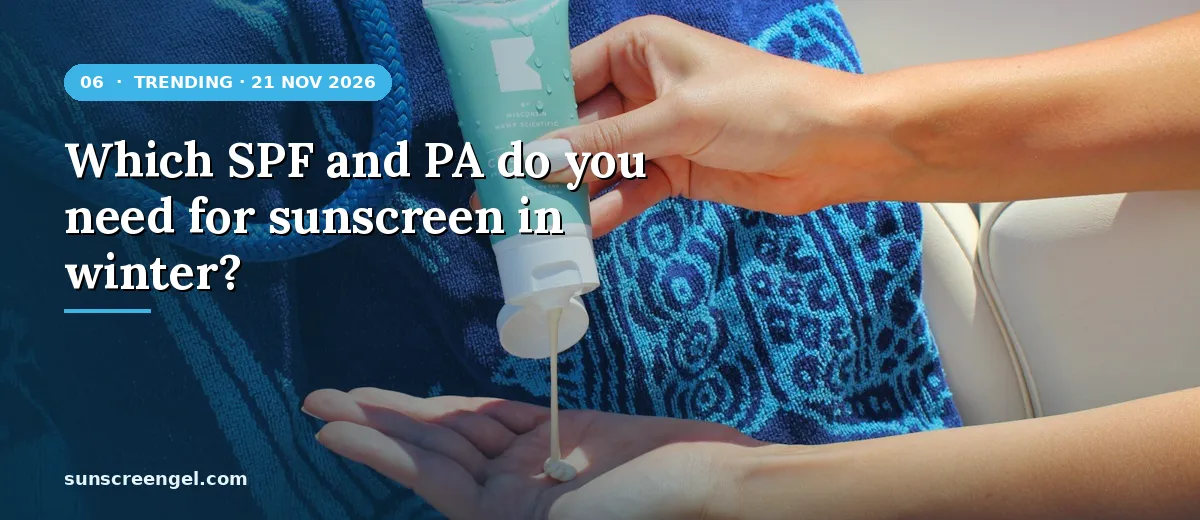
For daily city life, choose broad-spectrum SPF 30 or higher with PA+++ or PA++++. For hills, snow or long outdoor days, go for SPF 50 PA++++.
Here is what each label means:
- SPF measures protection against UVB, the burning rays.
- PA rates UVA protection. It comes from the PPD (persistent pigment darkening) test. PA++++ means a PPD of 16 or more.
- Broad spectrum means the product covers both UVA and UVB.
Because UVA barely changes with the season, PA matters most for winter tanning and pigmentation. Our SPF and PA explainer covers the numbers in more depth.
Which sunscreen in winter suits your skin type?

Pick your winter sunscreen by skin type, not by season alone. Dry air changes what feels comfortable, but oily skin still gets oily.
| Skin type | Winter problem | Best sunscreen approach |
|---|---|---|
| Oily / acne-prone | Still shiny by noon; heavy creams clog pores | Non-comedogenic gel; light moisturiser only if tight |
| Combination | Dry cheeks, oily T-zone | Gel sunscreen; extra moisturiser on cheeks |
| Dry | Flaking, tightness, dullness | Ceramide or glycerin moisturiser first, then sunscreen |
| Sensitive | Stinging, redness in cold wind | Fragrance-free formula; patch test first |
| Melasma / pigmentation-prone | Dark spots return quickly | SPF 50 PA++++ daily, even indoors near windows |
If your skin is very dry, read our full guide to sunscreen for dry skin. Likewise, oily skin types can check our oily skin sunscreen guide.
For many people, the simplest winter fix is layering. First, apply a moisturiser. Then, add a lightweight gel sunscreen on top. You get hydration and protection without a heavy, greasy feel. SeoulBloom keeps a small range of moisturisers for this step.
How do you apply sunscreen in winter the right way?
Apply sunscreen in winter the same way you would in summer, just over a well-moisturised base. Follow these steps every morning.
- Cleanse gently. Use lukewarm water, not hot water. Hot water strips oils from already dry skin.
- Moisturise first. Pat on a moisturiser with ceramides, glycerin or hyaluronic acid. Then wait a minute or two.
- Measure enough sunscreen. Use about two finger-lengths for the face and neck. See our guide on how much sunscreen to apply on face.
- Cover the missed spots. Include ears, the hairline, the back of the neck and the backs of your hands.
- Wait before going out. The AAD suggests applying at least 15 minutes before sun exposure.
- Protect your lips. Cold wind and UV dry them out. So use an SPF lip balm.
- Reapply outdoors. Top up every two hours during long outdoor time, like a wedding, a cricket match or a hill trek.
One practical tip comes from a Dermatology Times Q&A published on 18 November 2026. Nurse practitioner Jill Cowan suggested keeping sunscreen where you will see it, such as your bathroom shelf or work desk. That small change makes daily use easier.
Do you need sunscreen in winter indoors or on cloudy days?

On cloudy days, yes. Indoors, it depends on how close you sit to a window.
UVA passes through ordinary window glass, as the Skin Cancer Foundation notes. So if your desk or car seat gets direct sunlight, apply sunscreen in winter just as you would outdoors. On the other hand, a room far from windows carries little UV risk.
Car journeys deserve special mention. Many Indians spend an hour or more in traffic each day. Side windows often let in more UVA than the windscreen. As a result, the side of your face nearest the window can tan more over time.
Cloudy days are trickier still. You feel no heat, so you assume no sun. However, clouds cut UV by only about half, so you still need protection.
Who needs extra sun protection in winter?

Some groups face more winter UV than others. If you fit one of these, take extra care.
- Outdoor workers and riders: Delivery partners, traffic police, farmers and two-wheeler commuters spend hours in the midday sun. A helmet visor does not cover the jaw or neck.
- Children: Winter holidays mean long afternoons in parks and on rooftops. Kids also forget to reapply, so a hat helps.
- People using retinoids or exfoliating acids: Many people start tretinoin, AHAs or peels in winter. These can make skin more sun-sensitive, so daily SPF is essential.
- Anyone with melasma: Pigmentation often returns with small, repeated doses of UV and visible light. Consistency matters more than strength here.
- Travellers to the hills: Altitude and snow raise UV sharply, as MedlinePlus and the Skin Cancer Foundation explain.
Wedding season adds another layer. Outdoor ceremonies, haldi functions and long photo sessions often run through the brightest hours. So plan sunscreen in winter around these events, not just around the weather report.
How do you reapply sunscreen in winter over makeup?
Reapply sunscreen in winter with a light hand over makeup. You do not need to wash your face and start again.
First, blot away oil or sweat with a tissue. Next, press a thin layer of gel or lotion sunscreen over the face with your fingertips or a damp sponge. Pressing, rather than rubbing, keeps your base in place.
Alternatively, carry an SPF mist or powder for quick touch-ups. These are handy for top-ups, but they rarely give full label protection on their own. Therefore, treat them as a backup to your morning layer, not a replacement.
Indoors, one careful morning application is usually enough for most office days. Outdoors, however, stick to the two-hour rule. Set a phone reminder if you tend to forget.
Winter sunscreen myths vs facts
Winter brings several popular myths. Here are the common ones, checked against health-body guidance.
| Myth | Fact |
|---|---|
| “No heat means no UV.” | Heat is infrared; UV is separate and stays present on clear winter days. |
| “Fog and smog protect my skin.” | WHO notes UV can stay high under cloud cover; haze is not sunscreen. |
| “Dark skin does not need winter SPF.” | Melanin-rich skin tans and pigments easily, so UVA protection still matters. |
| “My moisturiser with SPF 15 is enough.” | Most people apply too little; AAD recommends SPF 30 or higher. |
| “Winter sunbathing for vitamin D means no sunscreen.” | Daily SPF use rarely causes deficiency; diet and testing matter more. |
| “Snow trips only need sunglasses.” | Snow reflects up to 80% of UV, so skin needs SPF 50 too. |
For the vitamin D question, read our detailed post on sunscreen and vitamin D.
What is a good sunscreen in winter for oily and combination skin?

A lightweight, non-comedogenic gel with SPF 50 PA++++ works well for oily and combination skin in winter. It sits comfortably over moisturiser, and it does not feel greasy under woollens or scarves.
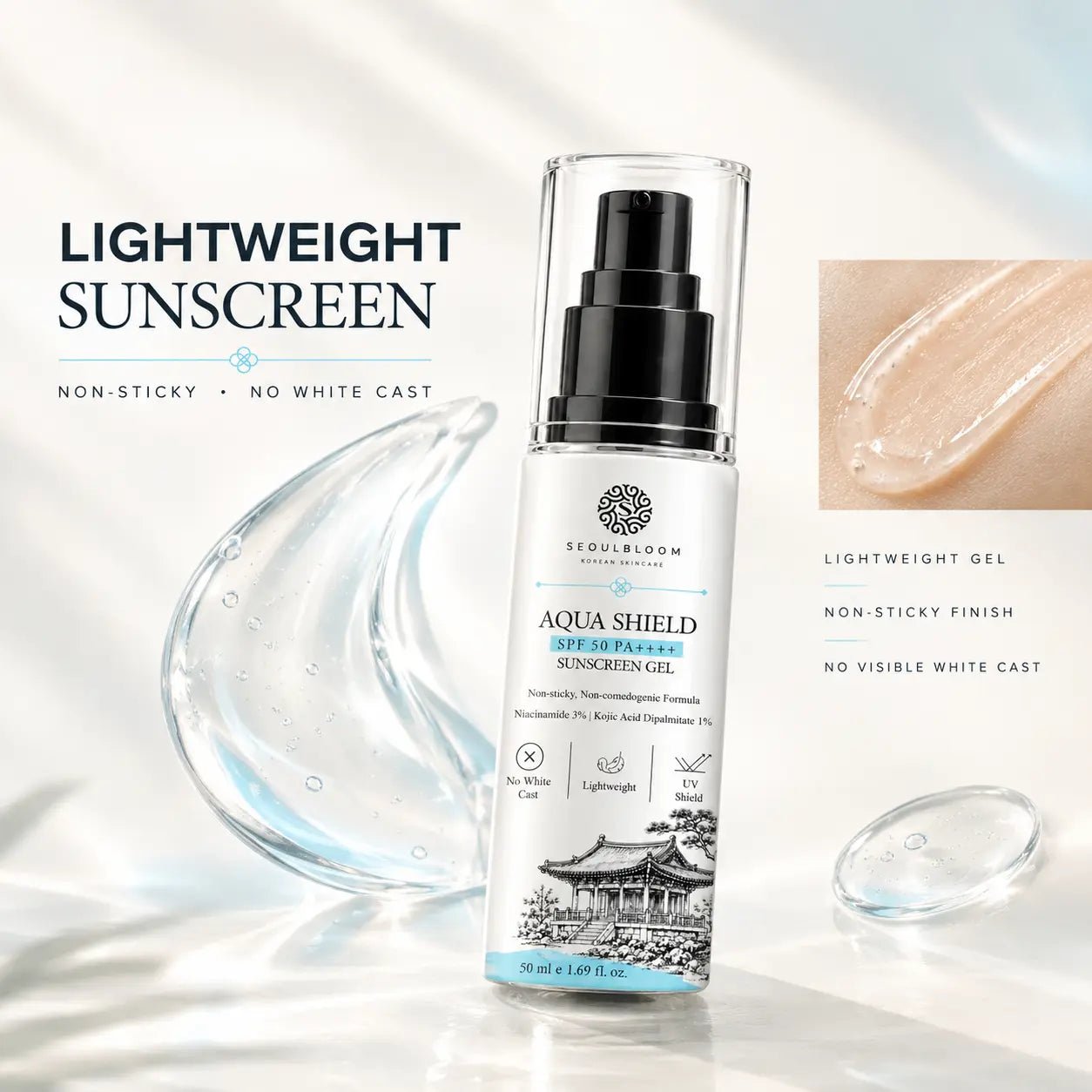
That is where our own Aqua Shield gel fits. We make it, so weigh our view with that in mind. Still, its specs are easy to check: SPF 50 PA++++, a 60 ml tube at ₹799, and a gel texture with no white cast. It also contains 3% niacinamide and 1% kojic acid dipalmitate, which support an even-looking tone.
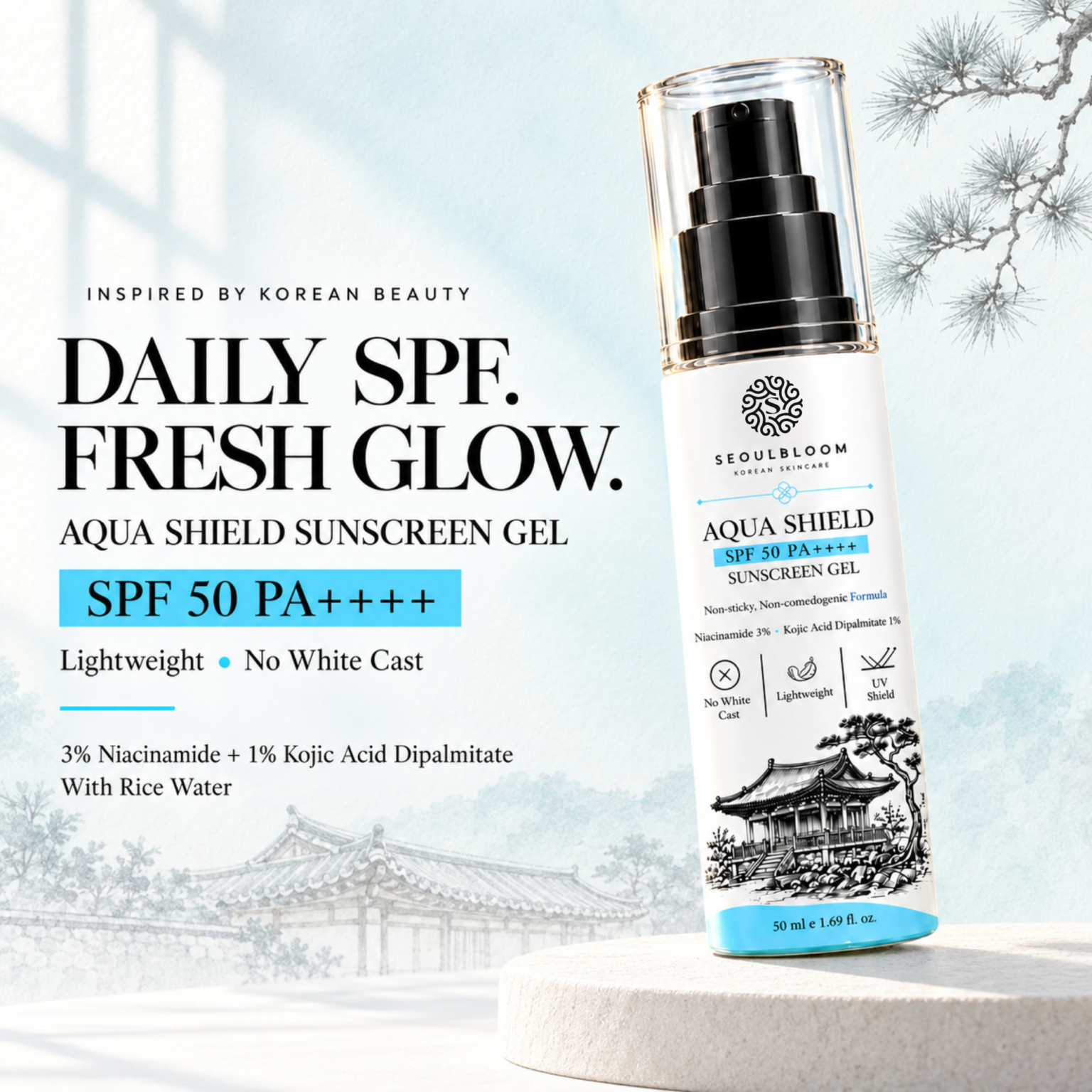
Our pick
SeoulBloom Aqua Shield SPF 50 PA++++ Sunscreen Gel
- SPF 50 PA++++ broad-spectrum UVA/UVB protection
- Lightweight, non-sticky gel — no white cast
- Non-comedogenic; suits oily & combination skin
- 3% niacinamide + 1% kojic acid dipalmitate for even-looking tone
- 60 ml · ₹799
₹999
For very dry skin, the gel alone may feel too light in December. In that case, layer it over a richer moisturiser. Alternatively, choose a cream-based sunscreen that you enjoy using every day. Ultimately, the best sunscreen is the one you actually wear.
How else can you protect your skin from winter sun?
Sunscreen works best as one part of a wider routine. Clothing and shade do much of the heavy lifting.
- Sunglasses: WHO recommends wraparound sunglasses with 99–100% UVA and UVB protection. This matters most on snow.
- Hats and scarves: A cap or stole shields the face, ears and neck during long walks.
- Shade at midday: Winter sunbathing feels lovely. Even so, keep long sessions to early morning or late afternoon.
- Lip care: Lips have very little melanin, so an SPF lip balm helps. SeoulBloom also has a lip care range for this.
- Barrier care: Short, lukewarm showers and regular moisturiser keep dry skin calmer.
Finally, watch your skin for any new or changing mole. If something looks unusual, see a dermatologist promptly.
Frequently asked questions
Do Indians really need sunscreen in winter?
Yes. UVA rays that cause tanning and pigmentation stay fairly constant through the year, and much of India gets bright winter sun. The WHO advises protection whenever the UV index reaches 3 or above.
Which SPF is best for sunscreen in winter?
For everyday city use, choose broad-spectrum SPF 30 or higher with PA+++ or PA++++. For hill stations, snow or long outdoor days, use SPF 50 PA++++ and reapply every two hours.
Can I skip sunscreen on foggy or smoggy days?
No. Fog and smog dim the sky, but they do not block UV reliably. Clouds cut UV by only about half, so daily sunscreen still makes sense.
Should I apply moisturiser before sunscreen in winter?
Yes, if your skin feels dry. Apply moisturiser first, wait a minute or two, and then apply sunscreen as the final morning step.
Is gel sunscreen suitable for winter?
Yes, for oily, combination and normal skin. If your skin is very dry, layer the gel over a rich moisturiser or pick a hydrating cream sunscreen.
Do I need sunscreen indoors in winter?
Only if you sit near a sunny window or travel by car for long periods. UVA passes through glass, so sunlit desks and car seats still expose your skin.
Does sunscreen stop vitamin D production in winter?
Real-world studies show daily sunscreen use rarely causes vitamin D deficiency. If you worry about low levels, ask your doctor for a blood test rather than skipping SPF.
How we researched this guide: We reviewed the top-ranking Indian pages for “sunscreen in winter”, including Nykaa, BeBeautiful, Smytten, POND’S India and Telangana Today. Most lacked cited sources, a clear PA explanation or city-level context, so we checked every claim against WHO, NIH MedlinePlus, the AAD and the Skin Cancer Foundation, and dated the news peg to The Week’s 20 November 2026 report. Read our editorial policy.
Sources & further reading
- The Week – Delhi records season’s coldest morning amid fog, poor AQI (20 Nov 2026)
- World Health Organization – Ultraviolet radiation fact sheet
- NIH MedlinePlus Magazine – Sunscreen in the winter
- American Academy of Dermatology – Why you need sun protection in the winter
- Skin Cancer Foundation – Winter sun safety
- Dermatology Times – Skin cancer prevention beyond summer (18 Nov 2026)

Written & fact-checked by
SeoulBloom Editorial Team — the skincare research and product team behind SeoulBloom. We formulate and sell sunscreen for Indian skin, test textures in Indian heat and humidity, and check every claim against dermatology bodies (AAD, WHO) and peer-reviewed research. Updated 21 November 2026. How we write & review.
Disclosure: SunscreenGel.com is run by the team behind SeoulBloom, and we link to SeoulBloom products where they fit. This article is for general education, not medical advice — see a dermatologist for skin conditions. Read our disclaimer. Last reviewed November 2026.