Quick answer: Sunscreen for pollution season does not block smoke particles, but it blocks the UV light that worsens pollution-related oxidative stress. Use broad-spectrum SPF 30+ with PA+++ or higher daily, even on hazy days. Reapply every two hours outdoors, and cleanse at night to remove particles.
Key takeaways
- Delhi’s CPCB AQI was 236 (‘poor’) on 22 November 2026, after 327 (‘very poor’) the day before.
- Sunscreen does not filter particles, yet it blocks UV, which can make pollution damage worse.
- UVA is about 95% of surface UV and passes through haze, so wear SPF on smoggy days too.
- Pick broad-spectrum SPF 30+ with PA+++ or PA++++, plus antioxidants such as niacinamide.
- Cleanse every night and support the barrier with a ceramide moisturiser.
Searches for sunscreen for pollution protection rise every winter, and this week shows why. On Sunday, 22 November 2026, Delhi’s air stayed in the ‘poor’ band, with smog over the city for another day.
Many people assume a grey, hazy sky means they can skip SPF. In fact, the opposite is closer to the truth. This guide explains what the latest AQI readings mean, how smog and sunlight affect Indian skin, and how to build a simple, evidence-based routine.
In this article
- What did Delhi’s air look like on 22 November 2026?
- Does sunscreen for pollution actually protect your skin?
- How does pollution damage Indian skin?
- Do you need sunscreen for pollution on a hazy, smoggy day?
- What should you look for in a sunscreen for pollution?
- How to use sunscreen for pollution: a daily routine
- Can tinted sunscreen help with pollution and pigmentation?
- Sunscreen for pollution: myths vs facts
- Which sunscreen for pollution suits your skin type?
- What else protects skin from pollution besides sunscreen?
- Mineral or chemical filters: which suits smoggy cities?
- How should commuters use sunscreen for pollution on the go?
- When is the sunscreen for pollution routine not enough?
- FAQ
What did Delhi’s air look like on 22 November 2026?

Delhi woke up to “poor” air on Sunday, 22 November 2026. The Central Pollution Control Board (CPCB) recorded a city average AQI of 236 that morning, as IANS reported via The Hans India at 7:28 AM IST.
That is a small improvement. Just a day earlier, on Saturday 21 November, the city AQI stood at 327 at 8:20 AM, which falls in the “very poor” band. However, several hotspots stayed bad on Sunday. According to Outlook India, Sirifort read 326 at 6 AM, while DTU read 314. Meanwhile, GRAP Stage II curbs remain in force across Delhi-NCR, and poor air is expected to persist until at least Tuesday.
| CPCB AQI band | Range | Delhi reading |
|---|---|---|
| Poor | 201–300 | City average 236 (22 Nov 2026) |
| Very poor | 301–400 | City average 327 (21 Nov 2026); Sirifort 326 (22 Nov, 6 AM) |
So, if you live in Delhi, Gurugram, Noida or any smoggy Indian city, your skin is meeting two stressors every day: fine particles and sunlight. That combination is why sunscreen for pollution season is trending now.
Does sunscreen for pollution actually protect your skin?
Partly, yes. Sunscreen does not filter smoke particles, but it blocks the UV light that makes pollution damage worse. In other words, it removes one half of a harmful pair.
Here is the logic. Pollution and UV both push the skin into oxidative stress. Free radicals then attack lipids, proteins and DNA. Moreover, a review in Discover Magazine notes that the combined exposure may cause more damage than either one alone. Dermatologist Thierry Passeron told the magazine that broad-spectrum sunscreen is “the best anti-aging prevention care”.
Therefore, think of sunscreen as the base layer. Cleansing, a healthy skin barrier and antioxidants then handle the particle side. In practice, no single product covers everything. Instead, small daily habits work together, and sunscreen is the one with the strongest evidence behind it.
How does pollution damage Indian skin?
Pollution mainly shows up as dark spots, dullness, dryness and early lines. For melanin-rich Indian skin, the pigment side often matters most.
Pigmentation and uneven tone
A systematic review published on 30 December 2025 pooled four cohorts with about 3,465 people. It found that long-term PM2.5 exposure leaned towards more pigment spots. However, the pooled estimate was not statistically significant, and the authors rated the evidence as low certainty. One included study did find brown spots rose by 9.5 percentile points per 10 µg/m³ of PM2.5 (Tjiu and Lu, 2025).
Barrier damage and dryness
UCLA Health explains that pollution can trigger oxidative stress, inflammation and a weaker skin barrier. As a result, skin may feel dry, red or reactive. It can also flare acne, eczema or rosacea.
Why sunlight makes particles worse
A 2021 lab study in the International Journal of Molecular Sciences exposed skin cells to PM2.5 plus UVA and visible light. The light made the particles more toxic than particles alone. Notably, winter particles were the most phototoxic in that study (Mokrzyński et al., 2021). Still, these were cultured cells, not people, so treat it as a mechanism, not proof.
Do you need sunscreen for pollution on a hazy, smoggy day?
Yes. Smog can look like cloud cover, yet UVA still reaches you. According to the WHO, UVA makes up about 95% of the UV that reaches the Earth’s surface. It penetrates deeper and drives tanning and ageing.
The WHO also warns that thin clouds have little effect on UV. Some airborne particles may scatter a little UV, as Discover notes. Even so, nobody can see how much protection a grey sky gives. So the safe habit is simple: wear SPF every day, haze or not. You can also check our UV index India guide for daily levels.
What should you look for in a sunscreen for pollution?
Choose a broad-spectrum formula with high UVA protection, a light texture and some antioxidant support. A special “anti-pollution” label matters far less than these basics.
- Broad spectrum, SPF 30 or higher. The American Academy of Dermatology recommends SPF 30+ with “broad spectrum” on the label.
- PA+++ or PA++++. PA grades rate UVA protection. PA++++ means a PPD of 16 or more.
- Antioxidants. UCLA Health lists niacinamide, green tea, and vitamins C and E as helpful against oxidative stress.
- Non-comedogenic, lightweight texture. Smog plus sweat can clog pores, so gels suit humid cities.
- Tint, if you have melasma. Iron oxides in tinted formulas add visible-light cover.
| Feature | Why it matters in smog | Priority |
|---|---|---|
| SPF 30–50 | Cuts UVB that adds to oxidative stress | Must have |
| PA+++ / PA++++ | Blocks UVA, which passes through haze | Must have |
| Niacinamide or vitamin E | Adds antioxidant support | Nice to have |
| Gel texture | Less residue for particles to stick to | Nice to have |
| Iron oxide tint | Visible-light cover for melasma-prone skin | Situational |
| “Anti-pollution” claim | Rarely backed by public test data | Optional |
SPF 30 or SPF 50 in smog season?
Both are solid choices. By definition, SPF 30 lets about 1/30 of burning UVB reach the skin, while SPF 50 lets about 1/50 through. That works out to roughly 97% versus 98% blocked under lab conditions.
The gap looks small on paper. In real life, however, people apply far less than the lab amount. So a higher SPF gives you a useful safety margin for thin or uneven layers. For long commutes or outdoor work, SPF 50 PA++++ is a sensible pick. Meanwhile, SPF 30 still works well for short trips if you apply enough. Our SPF 50 gel guide explains the numbers in more detail.
Also remember that a higher number does not last longer. Every sunscreen needs reapplying, usually every two hours outdoors. In short, the right amount and regular top-ups matter more than chasing the highest figure on the label.
Our pick for smoggy city days
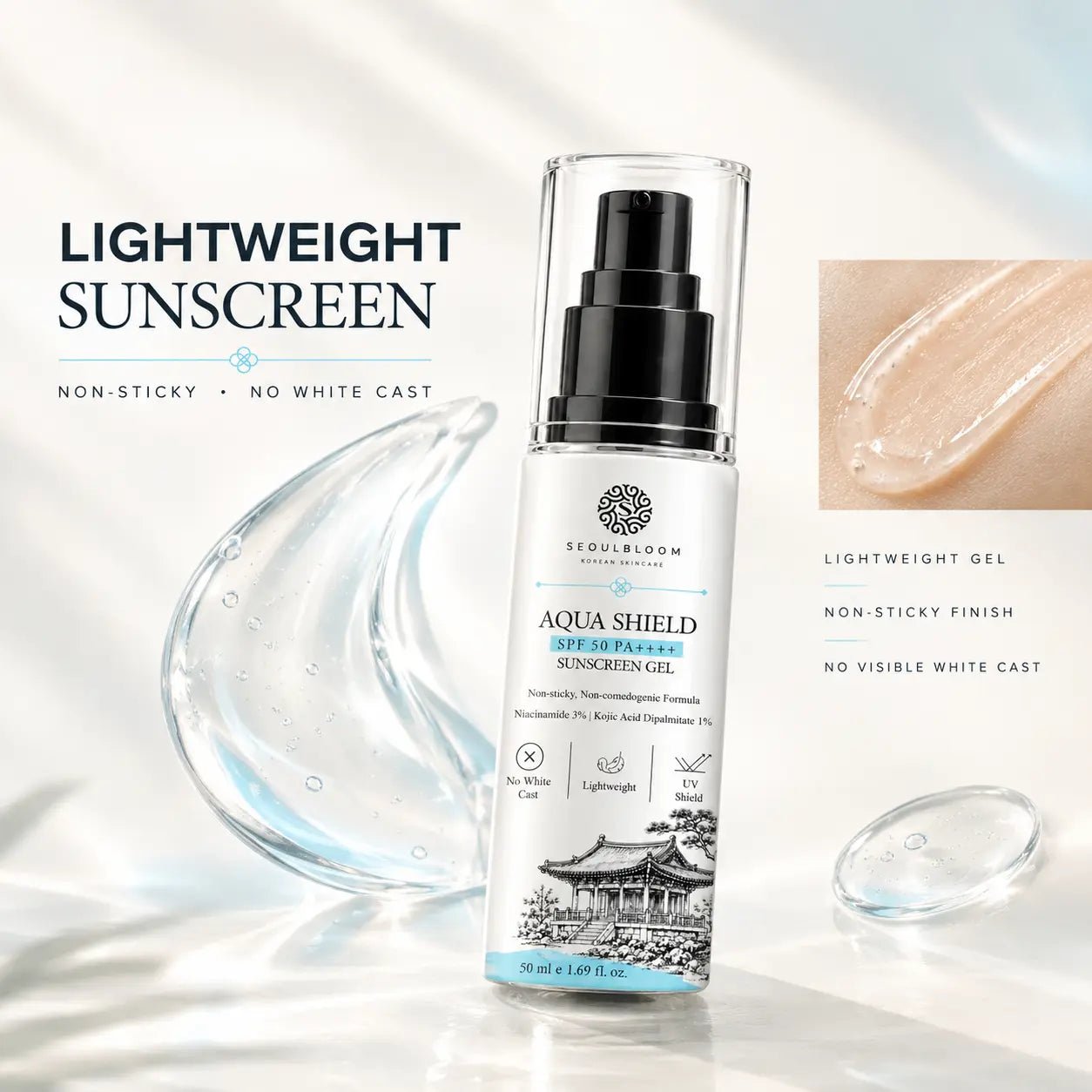
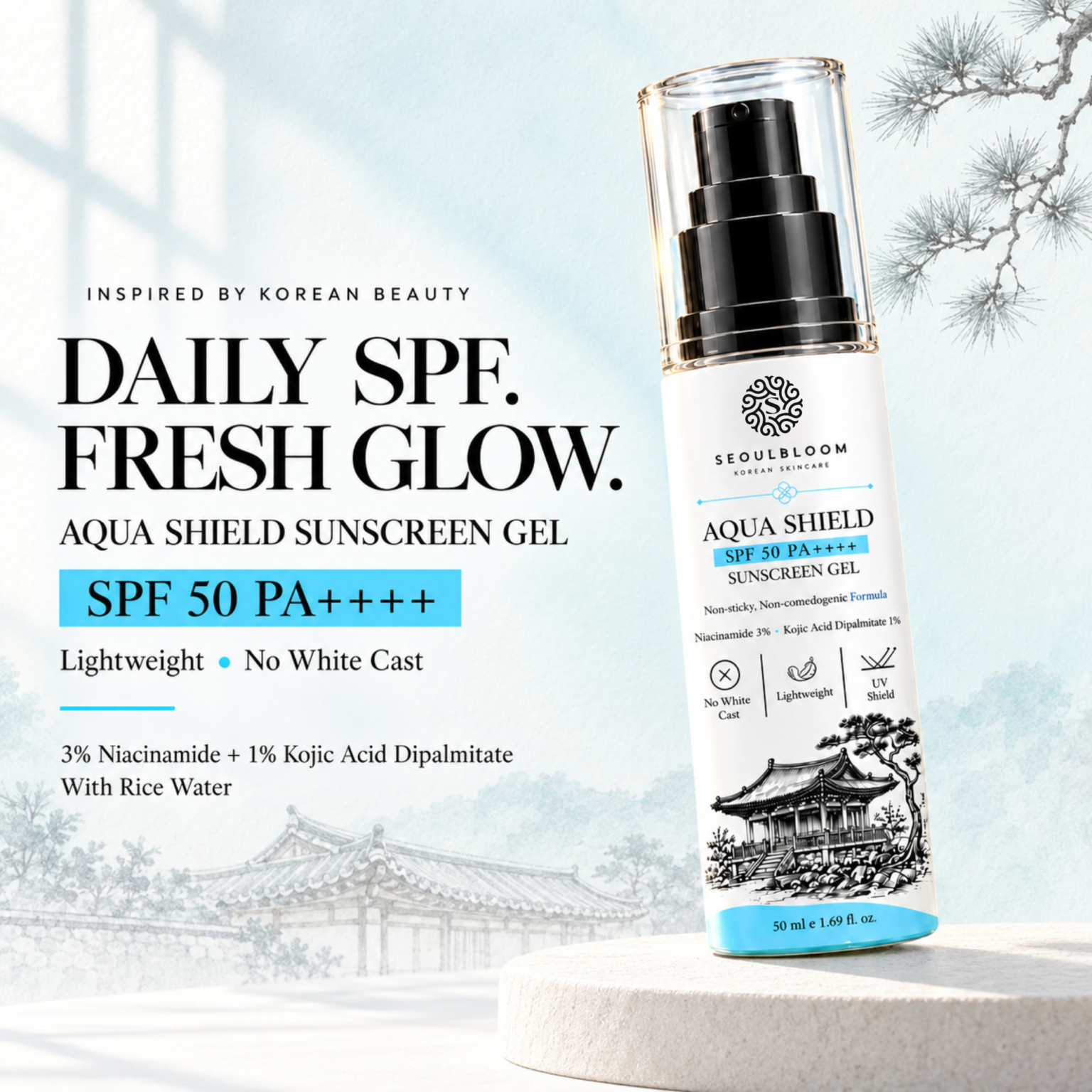
If you want one lightweight daily layer, a gel with SPF 50 PA++++ and niacinamide fits the checklist above.
Our pick
SeoulBloom Aqua Shield SPF 50 PA++++ Sunscreen Gel
- SPF 50 PA++++ broad-spectrum UVA/UVB protection
- Lightweight, non-sticky gel — no white cast
- Non-comedogenic; suits oily & combination skin
- 3% niacinamide + 1% kojic acid dipalmitate for even-looking tone
- 60 ml · ₹799
₹999
The SeoulBloom Aqua Shield gel lists 3% niacinamide, 1% kojic acid dipalmitate and vitamin E. It is untinted, though. So if you have melasma, you may still want a tinted layer on top. See the full SeoulBloom sunscreen range for other textures.
How to use sunscreen for pollution: a daily routine
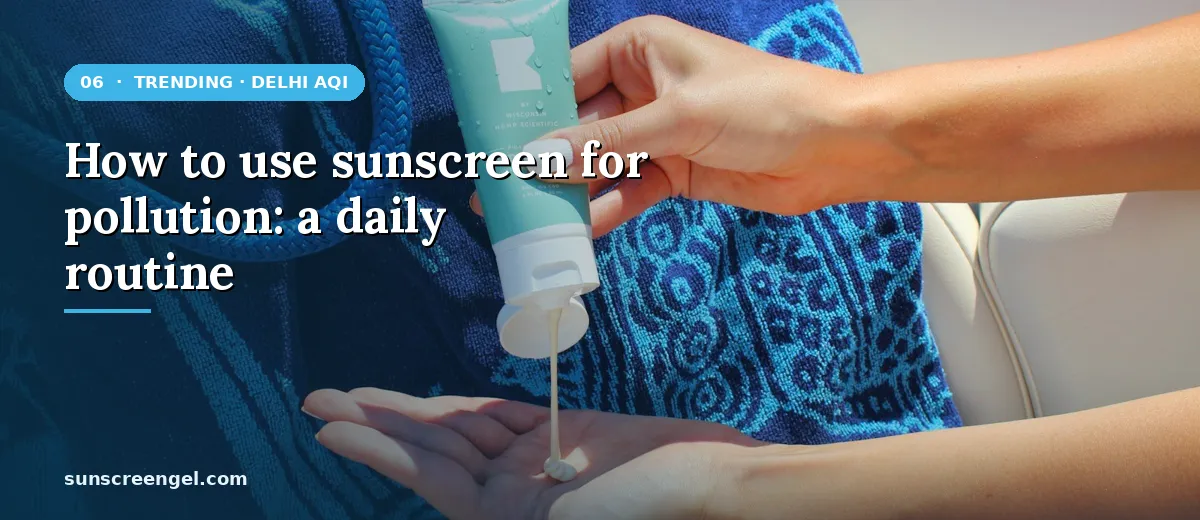
The routine is simple: cleanse, protect, then repair. Follow these steps on high-AQI days.
- Morning cleanse. Use a gentle, fragrance-free face wash if your skin is oily.
- Antioxidant layer. Apply a niacinamide or vitamin C serum, if you use one.
- Moisturise. A ceramide moisturiser supports the barrier, as UCLA Health advises.
- Apply sunscreen generously. Labs test SPF at 2 mg/cm², yet most people use only a quarter to half of that. For the face, that is roughly two finger-lengths.
- Wait 15 minutes. The FDA suggests applying about 15 minutes before you step out.
- Reapply every two hours outdoors. The FDA says to reapply at least every two hours, and more often if you sweat.
- Cleanse every night. This removes sunscreen, sweat and settled particles before bed.
Unsure about the amount? Our guide on how much sunscreen to apply on the face shows it step by step.
Can tinted sunscreen help with pollution and pigmentation?
It can help with pigmentation, especially melasma. Tinted formulas use iron oxides, which block some visible light that untinted filters miss.
A small 2025 randomised study in the Journal of Cosmetic Dermatology followed 42 women with melasma for five months of summer. Both groups improved. However, only the tinted group narrowed the colour gap between patches and normal skin (Polena et al., 2025). Notably, a skincare company funded that study. Thus, see it as encouraging, not final. If you have melasma, ask a dermatologist before changing your routine.
Sunscreen for pollution: myths vs facts
Smog season brings a fresh wave of skincare myths. Here are the common ones, checked against the sources above.
| Myth | Fact |
|---|---|
| Smog blocks the sun, so I can skip SPF. | UVA is about 95% of surface UV and still reaches you through haze. |
| Sunscreen keeps pollution particles off my skin. | No sunscreen is a particle shield; nightly cleansing removes them. |
| I need a special “anti-pollution” sunscreen. | Broad-spectrum SPF 30+ is the proven core; extra claims are often untested. |
| Washing my face many times a day helps. | Over-washing can harm the barrier; UCLA Health suggests a nightly cleanse. |
| Pollution damage is proven to cause dark spots. | Evidence leans that way, but a 2025 meta-analysis rated it low certainty. |
Which sunscreen for pollution suits your skin type?
The best formula depends on your skin type, because smog affects oily and dry skin differently.
Oily and acne-prone skin
Pick a non-comedogenic gel. Then cleanse well at night, since sweat and particles can clog pores. Our guide on sunscreen for oily skin explains matte options.
Dry and sensitive skin
Smog often leaves skin tight and itchy. So layer a ceramide moisturiser first, then a fragrance-free sunscreen. Also see our guide to sunscreen for sensitive skin.
Pigmentation-prone skin
Choose PA++++ and consider a tinted layer. In addition, avoid scrubbing, because irritation can deepen dark marks.
What else protects skin from pollution besides sunscreen?

Lifestyle steps matter as much as products. First, check the day’s AQI and limit long outdoor time when it is poor. Second, avoid outdoor exercise near busy roads at rush hour, as UCLA Health advises. Third, run a HEPA air purifier at home if you can. Finally, eat plenty of antioxidant-rich fruit and vegetables, such as amla, guava, spinach and tomatoes. Also, keep your skin routine short on bad-air days. Too many strong actives at once can irritate a barrier that smog has already stressed. So pause harsh scrubs and limit strong exfoliating acids until the air improves.
Mineral or chemical filters: which suits smoggy cities?

Both work, as long as the formula is broad spectrum. The choice mostly comes down to texture, skin type and how much white cast you accept.
Mineral filters such as zinc oxide and titanium dioxide absorb, reflect and scatter UV. According to Wikipedia’s sunscreen overview, the FDA classes both as generally recognised as safe and effective. Moreover, zinc oxide covers long UVA well. On the other hand, mineral formulas can leave a grey or white cast on medium and deep Indian skin tones.
Chemical (organic) filters, by contrast, usually feel lighter and blend clear. Many Indian gels combine both types. Therefore, judge a product by its SPF, PA grade and how it feels after eight hours in Delhi traffic, rather than by filter type alone.
| Filter type | Strength | Trade-off | Best for |
|---|---|---|---|
| Mineral (zinc oxide, titanium dioxide) | Gentle, good UVA cover from zinc | Possible white cast | Sensitive, reactive skin |
| Chemical / organic | Light, invisible finish | Some people find certain filters sting | Oily, humid-weather skin |
| Hybrid | Balance of feel and cover | Check the full label | Most daily commuters |
| Tinted mineral | Adds visible-light cover via iron oxides | Shade matching on Indian skin | Melasma-prone skin |
How should commuters use sunscreen for pollution on the go?

Commuters face the longest exposure, so they need a portable plan. Two-wheeler riders, auto users and people who walk to the metro all spend time beside traffic.
Before you leave home
Apply a full layer at least 15 minutes before you step out. Also cover the ears, the back of the neck and the hands, since the FDA lists these as commonly missed spots. In addition, a cloth or N95 mask and full sleeves cut the skin area exposed to both sun and grime.
During the day
Carry a small tube. First, blot sweat and grime with a clean tissue instead of rubbing. Then reapply a thin, even layer. If you wear makeup, a sunscreen stick or SPF powder makes midday touch-ups easier. However, treat powders as a top-up only, because most people cannot apply enough of them for full protection.
When you get home
Wash your face soon after a long commute rather than waiting until bedtime. As a result, particles spend less time on your skin. Finally, follow with a moisturiser to calm any tightness.
When is the sunscreen for pollution routine not enough?

Sometimes skin needs medical care, not just a better routine. A daily SPF habit helps prevent damage, but it does not treat existing conditions.
See a dermatologist if you notice any of these signs:
- Redness, itching or burning that lasts more than two weeks.
- New or spreading dark patches on the cheeks, forehead or upper lip.
- Acne that suddenly worsens during smog season.
- Eczema, psoriasis or rosacea flares, which pollution can trigger.
- Any mole or spot that changes in size, shape or colour.
Also ask a doctor before choosing products for babies, young children or during pregnancy. For children’s needs, our sunscreen for kids guide covers age-wise options.
Frequently asked questions
Does sunscreen protect against pollution?
Sunscreen does not filter smoke particles. However, it blocks UV light, which can make pollution damage worse. Pair it with nightly cleansing and a healthy skin barrier.
Should I wear sunscreen when Delhi AQI is poor?
Yes. Haze does not stop UVA, which makes up about 95% of surface UV. Wear broad-spectrum SPF 30 or higher every day, including smoggy days.
What SPF is best for pollution season in India?
Dermatologists suggest SPF 30 or higher with broad-spectrum protection. In Indian cities, SPF 50 with PA+++ or PA++++ gives a comfortable margin for missed spots.
Is anti-pollution sunscreen better than regular sunscreen?
Not necessarily. Broad-spectrum UV protection is the proven part. Antioxidants like niacinamide or vitamin E may add support, but many anti-pollution claims lack public test data.
How often should I reapply sunscreen on high-AQI days?
Reapply at least every two hours when you are outdoors. Reapply sooner if you sweat or wipe your face.
Does pollution cause pigmentation on Indian skin?
Studies link long-term PM2.5 exposure with more pigment spots. Still, a 2025 meta-analysis rated the evidence low certainty. Daily SPF and gentle care remain sensible.
Should I double cleanse in pollution season?
A gentle nightly cleanse removes sunscreen and particles. If you wear water-resistant sunscreen or makeup, a double cleanse can help. Avoid harsh scrubbing.
How we researched this guide: We reviewed the top-ranking Indian pages on pollution and skin (Outlook Luxe, Zee News, The Quint Fit, L’Oréal Paris India and a brand guide), most of which lacked sources, tables or AQI data. We then checked each claim against CPCB AQI reports from 22 November 2026, UCLA Health, the AAD, FDA, WHO and peer-reviewed studies on PubMed Central. Read our editorial policy.
Sources & further reading
- The Hans India (IANS): Delhi’s air quality remains ‘poor’, AQI 236 — 22 Nov 2026
- Outlook India: Delhi AQI today, 22 Nov 2026
- Tjiu & Lu (2025): Long-term PM2.5 exposure and clinical skin aging — meta-analysis
- Mokrzyński et al. (2021): PM-induced oxidative stress mediated by UVA-visible light
- UCLA Health: Simple steps to protect your skin from everyday pollution
- American Academy of Dermatology: How to select a sunscreen
- FDA: Sunscreen — how to help protect your skin from the sun
- WHO: Radiation — ultraviolet (UV) Q&A
- Polena et al. (2025): Tinted vs untinted sunscreen in melasma

Written & fact-checked by
SeoulBloom Editorial Team — the skincare research and product team behind SeoulBloom. We formulate and sell sunscreen for Indian skin, test textures in Indian heat and humidity, and check every claim against dermatology bodies (AAD, WHO) and peer-reviewed research. Updated 22 November 2026. How we write & review.
Disclosure: SunscreenGel.com is run by the team behind SeoulBloom, and we link to SeoulBloom products where they fit. This article is for general education, not medical advice — see a dermatologist for skin conditions. Read our disclaimer. Last reviewed November 2026.