Quick answer: A natural sunscreen usually means a product with mineral filters like zinc oxide plus plant extracts. The new brachycerine plant study, covered on 23 November 2026, is promising but lab-only. For now, kitchen oils give very low SPF, so choose a tested SPF 30+ PA+++ sunscreen instead.
Key takeaways
- On 23 November 2026, The Week covered a study where the plant compound brachycerine blocked UV-driven DNA damage in skin samples.
- The research is lab-stage only, with no SPF or PA rating, and no product contains it yet.
- Most products sold as natural sunscreen depend on zinc oxide or titanium dioxide for real UV protection.
- Coconut and olive oils measured only about SPF 8 in a lab study, so they cannot replace sunscreen.
- Choose SPF 30 or higher with PA+++ or PA++++, apply about a quarter teaspoon to the face, and reapply every two hours outdoors.
Natural sunscreen is trending again after a rainforest plant compound protected human skin samples from UV damage in a new study. On 23 November 2026, The Week reported on brachycerine, an alkaloid from a Brazilian tree, and the story spread quickly across Indian beauty feeds.
So, does this mean you can swap your SPF for something plant-based? Not yet. Below, we explain what the study really showed, what natural sunscreen labels mean in India, why coconut oil and DIY mixes fall short, and how to pick a tested formula for your skin type and season.
In this article
- What did the new natural sunscreen study actually find?
- Can you buy a brachycerine sunscreen in India yet?
- What does “natural sunscreen” mean on an Indian label?
- Natural vs mineral vs chemical sunscreen: how do they compare?
- Do coconut oil, aloe vera or haldi protect you from the sun?
- Why are DIY sunscreen recipes risky?
- Why does UVA protection matter so much for Indian skin?
- Is zinc oxide a natural sunscreen ingredient?
- How do you choose a natural sunscreen in India?
- Which natural sunscreen suits your skin type and season?
- How much sunscreen should you apply each time?
- Natural sunscreen myths vs facts
- Where does a lightweight gel sunscreen fit in?
- What should you watch for next in natural sunscreen research?
- FAQ
What did the new natural sunscreen study actually find?

In short, a rainforest plant compound protected human skin samples from UV damage in the lab. On 23 November 2026, The Week highlighted the research, and it quickly spread through beauty feeds. The original paper appeared in the journal Photochemistry and Photobiology, with a press release dated 4 November 2026.
The compound is called brachycerine. It is an alkaloid found in the leaves of Psychotria brachyceras, a tree from Brazil’s Atlantic rainforest. According to the EurekAlert! news release, the team at the Federal University of Rio Grande do Sul (UFRGS) tested it in skincare formulas.
Here is what the researchers reported:
- Formulas with brachycerine, or a leaf extract, prevented DNA damage after UVA and UVB exposure.
- They also protected the integrity of nerve endings in the skin samples.
- Brachycerine was not toxic to mammalian cells in their tests.
- The plant can be propagated from cuttings, so the authors call it a sustainable source.
The corresponding author, Arthur Germano Fett-Neto, described a dual action. First, the molecule absorbs UV light. Second, it acts as an antioxidant against the reactive molecules that UV creates in cells.
Can you buy a brachycerine sunscreen in India yet?
No. This is early lab research, and no product with brachycerine is on sale in India or anywhere else. The tests used skin samples, not people wearing a sunscreen outdoors.
Moreover, the public summaries do not report an SPF value or a PA rating. Those numbers only come from standardised tests on real human skin. A new filter also needs years of safety work and regulatory review before it reaches a shelf.
For context, the US approved bemotrizinol in 2026, and it was the first new US filter in over 25 years. Our post on bemotrizinol sunscreen explains how slow that path can be. So, treat brachycerine as promising science, not a shopping option.
What does “natural sunscreen” mean on an Indian label?
Usually, it means the brand uses mineral UV filters, plant extracts, or both. However, there is no single legal definition of “natural” for sunscreen in India. As a result, two products with the same word on the front can work very differently.
In practice, most products sold as natural sunscreen rely on zinc oxide or titanium dioxide. These are mineral filters, and they do the real UV work. Meanwhile, the aloe, green tea or sandalwood in the formula mainly adds feel and skin comfort.
Indian rules are also tightening. In November 2025, ELLE India reported that a Bureau of Indian Standards (BIS) standard requires SPF claims to be proven with an ISO-aligned test on human skin. Therefore, the number on the label matters more than the word “natural” beside it.
If you want the basics first, read what sunscreen is and how SPF and PA work.
Natural vs mineral vs chemical sunscreen: how do they compare?
Simply put, “natural” is a marketing word, while “mineral” and “chemical” describe how the filters work. The table below sorts out the overlap.
| Feature | “Natural” sunscreen | Mineral sunscreen | Chemical (organic) sunscreen |
|---|---|---|---|
| Main UV filters | Usually zinc oxide or titanium dioxide, plus plant extracts | Zinc oxide, titanium dioxide | Avobenzone, octocrylene, Tinosorb S/M, bemotrizinol and others |
| Legal definition | None for “natural” | Defined by its active filters | Defined by its active filters |
| How it works | Depends on the filters inside | Sits on skin; absorbs and scatters some UV | Absorbs UV and releases it as heat |
| White cast on Indian skin | Often visible if zinc-heavy | Can be visible on medium-to-deep tones | Usually none |
| Texture | Often thicker | Often thicker | Usually lighter, gel or fluid |
| Sensitive skin | Plant extracts and essential oils can irritate | Often well tolerated | Some people react to certain filters |
| What to check | SPF, PA, filter list | SPF, PA, tint | SPF, PA, broad spectrum |
Our guide to chemical vs mineral filters goes deeper into each option.
Do coconut oil, aloe vera or haldi protect you from the sun?
Not on their own. Kitchen oils and herbs give very low, unreliable UV protection. For example, a 2010 lab study in Pharmacognosy Research by Kaur and Saraf measured the in vitro SPF of herbal oils used in Indian cosmetics.
| Oil tested (in vitro) | Approximate SPF reported | What it means |
|---|---|---|
| Olive oil | About 8 | Highest fixed oil, still far below SPF 30 |
| Coconut oil | About 8 | Not a sunscreen substitute |
| Castor oil | About 6 | Too low for Indian sun |
| Almond oil | About 5 | Too low |
| Mustard oil | About 3 | Minimal |
| Tulsi and peppermint oils | About 7 | Essential oils can also irritate skin |
Importantly, these numbers come from a screening method with diluted oils in a lab. The authors note that it does not replace testing on human skin. Real use would likely give even less, because oil spreads thin and unevenly.
Similarly, no trusted body lists aloe vera, haldi or sandalwood as a UV filter. They can soothe or moisturise skin. Still, they cannot replace a tested SPF.
Why are DIY sunscreen recipes risky?
Because nobody tests them, so you never know your real protection. A 2019 study in Health Communication reviewed 189 homemade sunscreen pins on Pinterest. According to PBS NewsHour, almost 70% of the recipes offered insufficient protection.
In addition, about a third of those pins claimed SPF numbers from 2 to 50. None had proof. Most recipes mixed coconut oil, shea butter, beeswax and essential oils, sometimes with zinc.
Even zinc oxide powder does not fix the problem at home. It needs even dispersion across the film, and kitchen mixing cannot guarantee that. As a result, some patches of skin get little cover.
Also, a home mix has no preservative system, so it can spoil quickly in humid Indian kitchens. It also has no expiry date or stability data.
In India, DIY “sunscreen” reels with curd, besan and coconut oil trend every summer. They may feel nice. However, they do not protect you from UVA-driven tanning or UVB burns.
Why does UVA protection matter so much for Indian skin?
UVA rays drive tanning, dark spots and the look of uneven tone. That is why the PA rating deserves as much attention as SPF on any label, natural or not.
SPF mainly measures protection from UVB, the rays that cause sunburn. Brown and deeper Indian skin tones burn less easily. However, they tan and pigment readily, because melanin responds strongly to UVA.
UVA also passes through clouds and window glass. So, it reaches you on hazy winter days in Delhi, in office cabins near windows, and in cars on long commutes.
For this reason, a natural sunscreen with SPF but no PA rating gives you only half the picture. Look for PA+++ or PA++++. On European-style labels, look for the UVA logo in a circle or a PPD value instead.
Finally, remember that even the brachycerine study tested both UVA and UVB. Any future plant filter will need to prove broad-spectrum cover too.
Is zinc oxide a natural sunscreen ingredient?
Partly. Zinc oxide starts from a mined mineral, but cosmetic grades are refined and processed in labs. That is why it sits under the “natural” banner on many labels.
Notably, in 2019 the US FDA proposed that zinc oxide and titanium dioxide were the only two of 16 filters with enough data to be “generally recognised as safe and effective”, as the Skin Cancer Foundation explains. The FDA asked for more data on the others. That request did not mean they were unsafe.
Zinc oxide covers both UVA and UVB well. On the other hand, it can leave a white or grey cast on wheatish, dusky and deep Indian skin tones. Tinted versions help with this.
Dermatologists often suggest mineral filters for sensitive skin. Our guide to sunscreen for sensitive skin covers what else to avoid.
How do you choose a natural sunscreen in India?
Start with the numbers, then the filters, then the feel. Follow these steps in order:
- Check SPF 30 or higher. The American Academy of Dermatology (AAD) recommends at least SPF 30 and broad-spectrum cover.
- Look for PA+++ or PA++++. This rating shows UVA protection, which drives tanning and dark spots.
- Read the active filters. Zinc oxide or titanium dioxide should appear if the product claims to be mineral.
- Skip “sunblock” and “chemical-free” hype. Instead, trust tested SPF and PA numbers.
- Avoid heavy fragrance and essential oils if your skin stings or reddens easily.
- Test for white cast. Swatch it on your jawline in daylight before you buy a full tube.
- Match the texture to your season. Choose a gel or fluid for humid months, and a lotion for dry winters.
Which natural sunscreen suits your skin type and season?
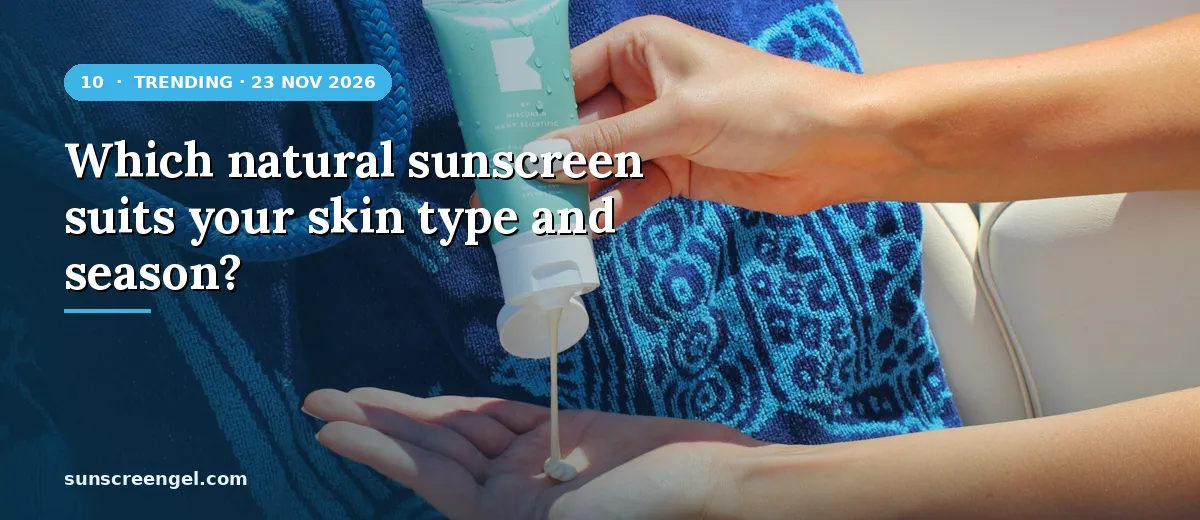
The best choice depends on oil levels, sensitivity and climate. Use this table as a quick guide.
| Skin type or situation | Look for | Avoid |
|---|---|---|
| Oily or acne-prone | Gel or fluid, non-comedogenic, matte finish | Coconut oil bases, heavy butters |
| Dry | Lotion with glycerin or ceramides | Alcohol-heavy gels in winter |
| Sensitive | Zinc oxide, fragrance-free | Essential oils, strong botanical blends |
| Medium-to-deep tones | Tinted mineral or sheer chemical filters | Untinted high-zinc pastes |
| Monsoon and humid cities like Mumbai, Chennai, Kolkata | Water-resistant, lightweight gel | Thick creams that slide off |
| Winter in Delhi or Lucknow | Hydrating SPF 30–50 over moisturiser | Skipping SPF on hazy days |
Also, check the day’s UV levels on our UV index India page. In much of South India, UV stays strong even in November.
How much sunscreen should you apply each time?
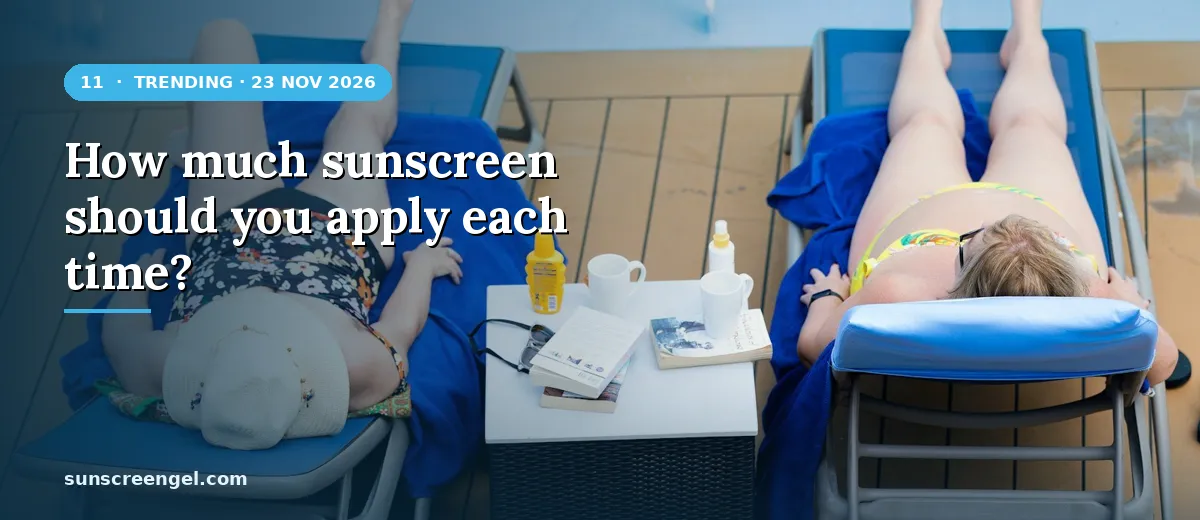
Apply enough to reach the SPF on the label. For the face and neck, most people need about a quarter teaspoon, roughly two finger lengths. Our guide on how much sunscreen to apply on face shows this step by step.
For the whole body, the NHS suggests around 6 to 8 teaspoons for an adult. Then reapply about every two hours outdoors, and after sweating, swimming or towel drying.
Thick mineral formulas tempt people to apply less, because they feel heavy. Consequently, the real SPF drops. Apply in two thin layers if one thick layer feels too much.
Finally, sunscreen is only one tool. The NHS also advises against relying on sunscreen alone. So, add shade, a hat and sunglasses between 10 am and 4 pm, especially on beach trips to Goa or summer treks.
Natural sunscreen myths vs facts
Many claims about natural sunscreen go viral without evidence. Here are the common ones.
| Myth | Fact |
|---|---|
| Coconut oil is a natural sunscreen. | Lab tests put it near SPF 8, and real use gives less. |
| Natural means safer. | Plant extracts and essential oils can irritate or sensitise skin. |
| Chemical-free sunscreen exists. | Every ingredient, including zinc oxide and water, is a chemical. |
| The new plant compound is a ready sunscreen. | Brachycerine is still at the lab stage, with no SPF rating. |
| Indian skin does not need sunscreen. | UVA still drives tanning, dark spots and pigmentation. |
| Mineral sunscreen needs no reapplying. | Sweat, rubbing and time remove every type of sunscreen. |
Where does a lightweight gel sunscreen fit in?
If you liked the idea of natural sunscreen for comfort, texture may be the real issue. Many mineral pastes feel heavy and look chalky in Indian heat. In that case, a tested gel can be easier to wear every day.
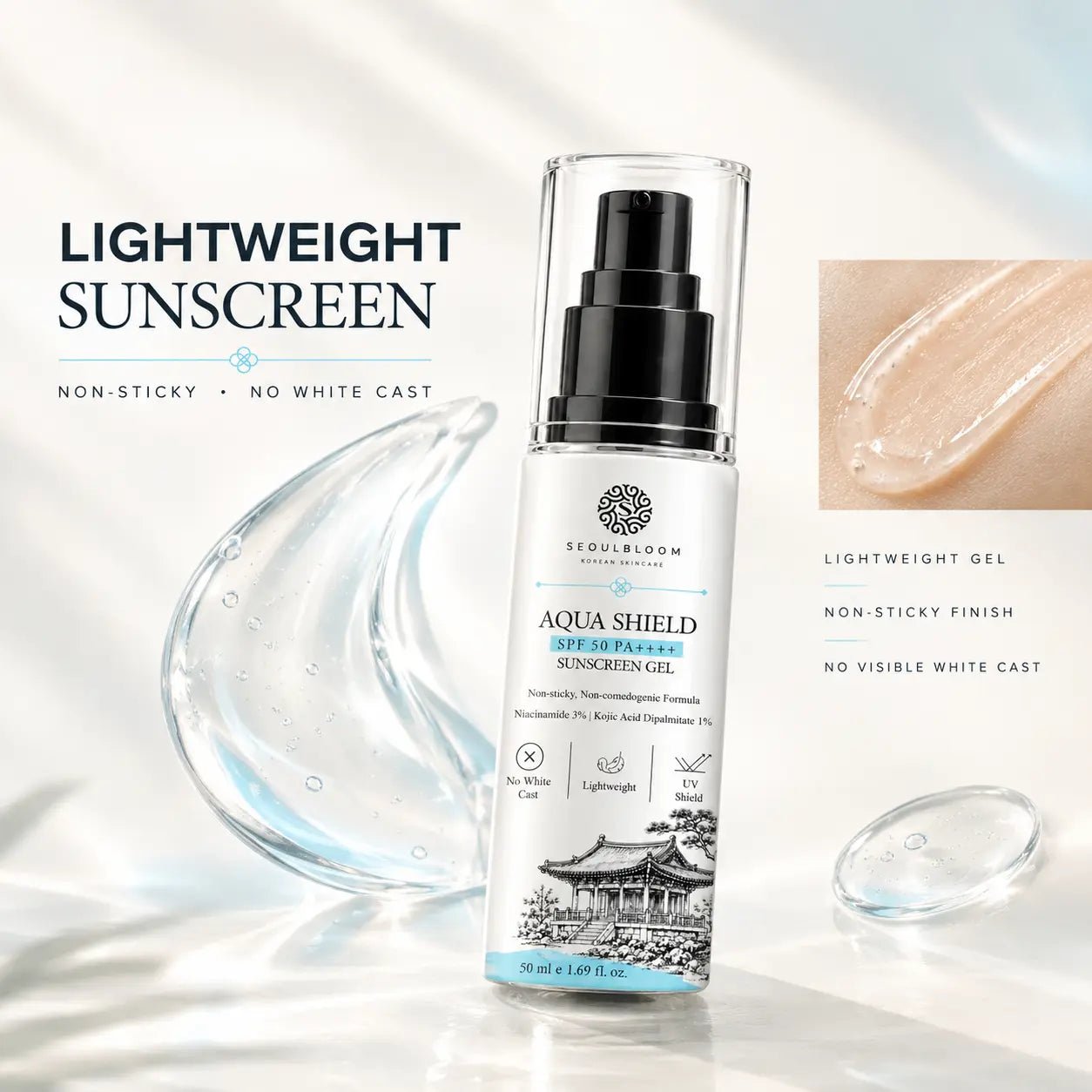
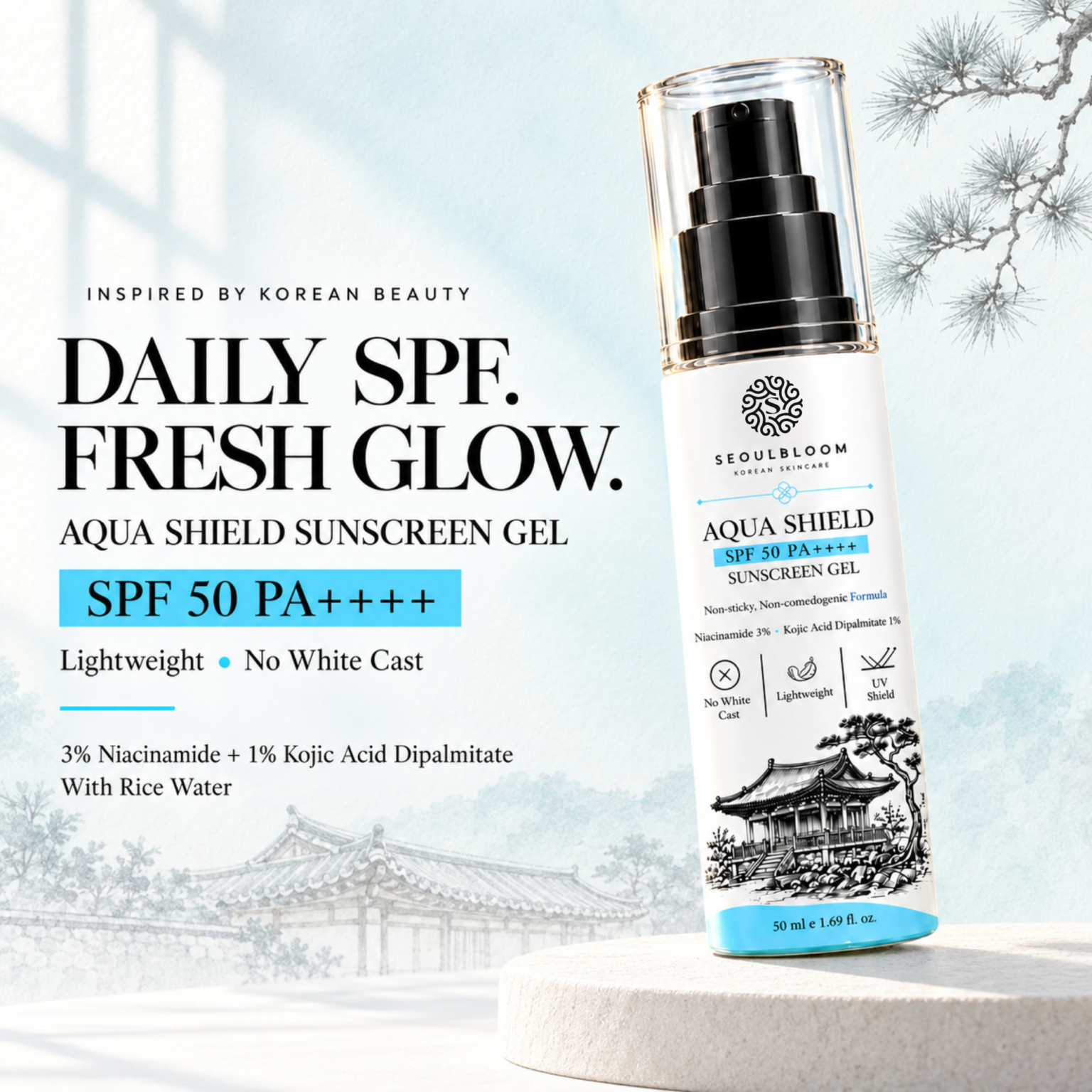
SeoulBloom Aqua Shield is not sold as a natural sunscreen. Instead, it offers lab-rated SPF 50 PA++++ in a light gel with no white cast. It also contains 3% niacinamide and 1% kojic acid dipalmitate, which support an even-looking tone.
Our pick
SeoulBloom Aqua Shield SPF 50 PA++++ Sunscreen Gel
- SPF 50 PA++++ broad-spectrum UVA/UVB protection
- Lightweight, non-sticky gel — no white cast
- Non-comedogenic; suits oily & combination skin
- 3% niacinamide + 1% kojic acid dipalmitate for even-looking tone
- 60 ml · ₹799
₹999
You can compare more textures in the SeoulBloom sunscreen collection. Whatever you pick, choose the formula you will apply generously every morning.
What should you watch for next in natural sunscreen research?
Plant-based UV filters are a busy research field, and interest keeps growing. Brachycerine is one of several natural compounds now under study. Next, researchers will need human trials, SPF and UVA testing, and long-term safety data.
Meanwhile, the safest move is simple. Use a tested broad-spectrum sunscreen with SPF 30 or more and PA+++ or higher. Then follow new filter approvals, rather than DIY trends, for real progress.
Frequently asked questions
Is there a truly natural sunscreen?
Not in a strict sense. Most products sold as natural sunscreen use zinc oxide or titanium dioxide, which start as minerals but are refined in labs. Plant extracts in these formulas mainly add feel, not tested UV protection.
Can coconut oil be used as a natural sunscreen?
No. A 2010 lab study measured coconut oil at roughly SPF 8, and real-world protection would likely be lower. Dermatologists recommend a tested sunscreen with at least SPF 30.
What is brachycerine?
Brachycerine is an alkaloid from the leaves of the Brazilian tree Psychotria brachyceras. In a 2026 study, formulas containing it protected human skin samples from UV-driven DNA damage. It is not yet available in any sunscreen product.
Is natural sunscreen better for sensitive skin?
Mineral filters such as zinc oxide are often well tolerated by sensitive skin. However, essential oils and botanical blends in some natural sunscreens can cause irritation. Choose a fragrance-free formula and patch test first.
Does natural sunscreen leave a white cast on Indian skin?
It can, especially if it contains a lot of zinc oxide. The cast shows more on wheatish, dusky and deep skin tones. Tinted mineral formulas or sheer gels reduce this problem.
Is homemade natural sunscreen safe to use?
It is not reliable. A 2019 study found almost 70% of homemade sunscreen recipes on Pinterest offered insufficient protection. Because nobody tests a home mix, you cannot know its SPF.
What SPF should a natural sunscreen have in India?
Look for SPF 30 or higher with a PA+++ or PA++++ rating. India’s strong UV and long sunny seasons make broad-spectrum cover important. Reapply about every two hours outdoors.
How we researched this guide: We read The Week’s 23 November 2026 report, the EurekAlert! and News-Medical summaries of the Photochemistry and Photobiology paper, and the PMC study on herbal oil SPF. We also reviewed top Indian natural sunscreen pages (StyleCraze, ThinkRight, CashKaro) and filled their gaps on PA ratings, testing, application amount and skin-type guidance, using AAD, NHS and Skin Cancer Foundation guidance. Read our editorial policy.
Sources & further reading
- The Week: A plant from a Brazilian rainforest could help create a natural sunscreen (23 Nov 2026)
- EurekAlert!: Brachycerine news release (4 Nov 2026)
- Photochemistry and Photobiology: do Nascimento et al., 2026 (DOI 10.1111/php.70171)
- Kaur & Saraf, In vitro SPF of herbal oils, Pharmacognosy Research (2010)
- PBS NewsHour: Homemade sunscreen on social media is a recipe for sunburn
- American Academy of Dermatology: How to select a sunscreen
- NHS: Sunscreen and sun safety
- Skin Cancer Foundation: What’s the sunscreen situation?
- ELLE India: India finally has a sunscreen rulebook

Written & fact-checked by
SeoulBloom Editorial Team — the skincare research and product team behind SeoulBloom. We formulate and sell sunscreen for Indian skin, test textures in Indian heat and humidity, and check every claim against dermatology bodies (AAD, WHO) and peer-reviewed research. Updated 23 November 2026. How we write & review.
Disclosure: SunscreenGel.com is run by the team behind SeoulBloom, and we link to SeoulBloom products where they fit. This article is for general education, not medical advice — see a dermatologist for skin conditions. Read our disclaimer. Last reviewed November 2026.