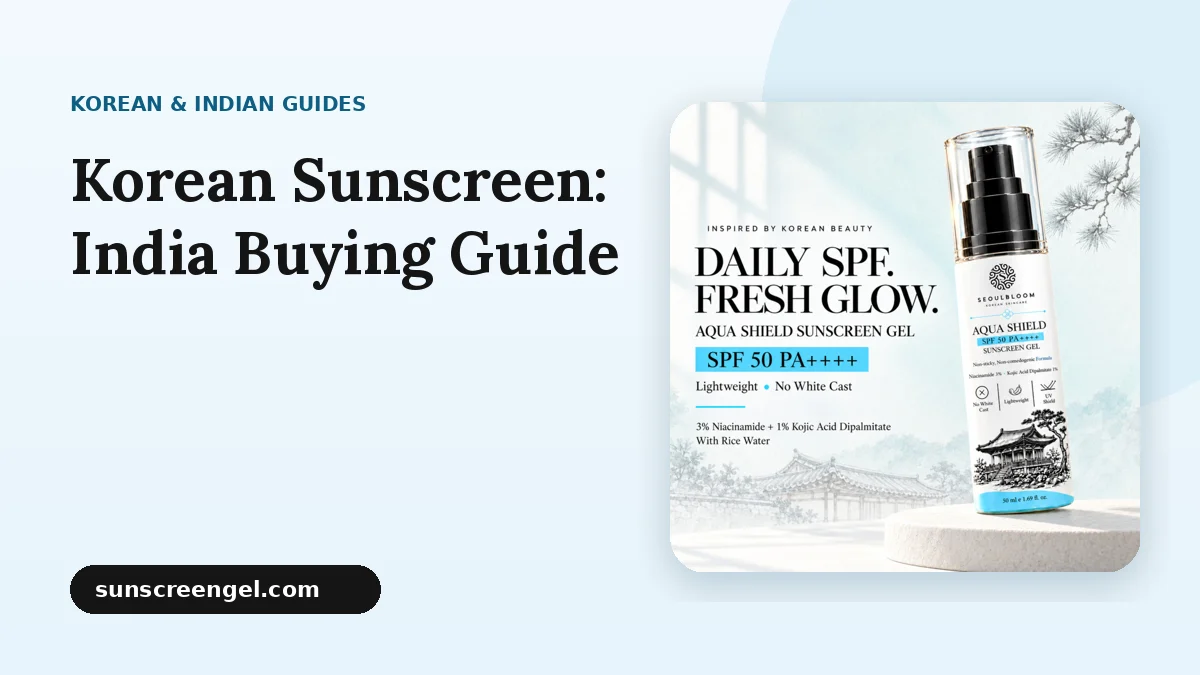
Quick answer: Korean sunscreen is popular in India for its light, no-white-cast textures and modern UV filters. It is not automatically better than Indian sunscreen. Choose any Korean sunscreen with SPF 30 or higher, PA+++ or PA++++, and a texture that suits your skin type, then apply about a quarter teaspoon to your face.
Key takeaways
- Korean sunscreen labels show SPF for UVB and PA for UVA; aim for SPF 30+ and PA+++ or PA++++ in India.
- Korean brands can use modern filters such as Tinosorb S and Uvinul A Plus, but protection depends on the full formula.
- Pick a gel or fluid for oily, humid conditions and a cream or milk for dry winters.
- Apply about a quarter to a third of a teaspoon on the face and reapply every two hours outdoors.
- Buy from official or authorised sellers to avoid fake or expired Korean sunscreen.
Korean sunscreen has become one of the most searched skincare products in India, and for good reason. Many formulas feel like a light serum, leave no white cast and sit well under makeup, which makes daily use far easier in Indian heat.
But a K-beauty label alone does not guarantee strong protection. In this guide, we explain what makes these products different, how to read SPF and PA ratings, which textures suit each skin type and season, and how much to apply. We also cover how to avoid fakes, so you can choose with confidence.
In this article
- What is Korean sunscreen, and why is it so popular in India?
- How is Korean sunscreen different from other sunscreens?
- What do SPF and PA mean on a Korean sunscreen label?
- Are Korean sunscreens better than Indian sunscreens?
- How to choose the best Korean sunscreen in India for your skin type
- Chemical, mineral or hybrid: which filter type suits you?
- Can sunscreen help with tanning and pigmentation on Indian skin?
- Which sunscreen textures work best in Indian weather?
- How much Korean sunscreen should you apply on your face?
- How often should you reapply sunscreen in India?
- How can you spot a fake or expired Korean sunscreen?
- What mistakes do people make with Korean sunscreen?
- Our verdict: is Korean sunscreen worth it for Indian skin?
- FAQ
What is Korean sunscreen, and why is it so popular in India?
Korean sunscreen is any sun protection product made by a South Korean brand, usually labelled with both an SPF and a PA rating. In India, it became popular because the formulas feel light, sink in fast and rarely leave a white cast.
That matters more than it sounds. Indian summers are hot, and the monsoon is humid. As a result, many people skip a heavy cream because it feels sticky by noon. A watery Korean sunscreen feels closer to a serum, so people actually wear it every day. Indeed, the best sunscreen is the one you apply daily, in the right amount.
However, “Korean” is not a quality grade. It describes where a brand comes from, not how well a tube protects you. Some Korean formulas are excellent, while others offer only modest UVA protection. You still need to read the label. For more regional guides, browse our Korean and Indian sunscreen guides.
How is Korean sunscreen different from other sunscreens?

Korean sunscreen differs in three ways: the UV filters it can use, the textures brands favour and the skincare ingredients they add. Protection itself depends on the formula, not the country.
Wider choice of modern UV filters
In South Korea, sunscreens fall under cosmetic rules rather than drug rules. Dermatologists quoted by NBC Select explain that this lets brands use newer filters such as Tinosorb S, Tinosorb M, Uvinul A Plus and Uvinul T 150. These filters cover UVA and UVB well and tend to stay stable in sunlight.
By contrast, the US approved bemotrizinol (Tinosorb S) only in June 2026. Several other filters common in Korean formulas still await US approval. We explain that story in our guide to bemotrizinol sunscreen.
Lighter, cosmetic-style textures
Korean brands compete hard on feel. So you will find watery essences, gels, fluids, milks, sticks and cushions. Most dry down without a greasy film. This suits oily skin and people who layer makeup.
Skincare actives in the base
Many formulas also add niacinamide, centella asiatica, hyaluronic acid or rice extract. These can make the product more pleasant. Still, they do not replace a serum, and they never raise the SPF on their own.
What do SPF and PA mean on a Korean sunscreen label?
On a Korean sunscreen, SPF shows protection from UVB (burning rays), while PA shows protection from UVA (tanning and ageing rays). You need both, especially on Indian skin that tans and pigments easily.
SPF measures how much longer skin takes to burn. According to the American Cancer Society, SPF 30 filters about 97% of UVB, and SPF 50 filters about 98%. Meanwhile, the PA system comes from Japan. It is based on a test called persistent pigment darkening (PPD), which measures how well a product stops UVA from darkening skin.
| PA rating | PPD value | UVA protection | Good for |
|---|---|---|---|
| PA+ | 2 to 4 | Low | Brief, low-UV exposure only |
| PA++ | 4 to 8 | Moderate | Indoor days with little window light |
| PA+++ | 8 to 16 | High | Daily city use |
| PA++++ | 16 or more | Very high | Indian summers, commutes, tanning and pigmentation concerns |
PA++++ was added to the scale in 2013, as noted in Wikipedia’s sunscreen overview. For Indian conditions, aim for SPF 30 or higher plus PA+++ or PA++++. Our SPF and PA explainer covers the science in more depth.
Are Korean sunscreens better than Indian sunscreens?

No, a Korean sunscreen is not automatically better than an Indian one. Both can protect well if they carry a high SPF, a strong PA rating and suit your skin.
The real differences are texture, filter choice, price and access. In particular, imported tubes often cost more in India, and stock can be patchy. On the other hand, many Indian brands now make light gels with PA++++ that handle heat well.
| Factor | Typical Korean sunscreen | Typical Indian sunscreen |
|---|---|---|
| Label | SPF plus PA rating | SPF, and often a PA rating too |
| Texture | Watery gels, essences, milks, sticks | Gels, creams, lotions; light gels are now common |
| UV filters | Often modern filters like Tinosorb S and Uvinul A Plus | Varies widely by brand |
| Price in India | Usually higher because of import costs | Wider range, many budget options |
| Availability | Online and select stores; fakes are a risk | Pharmacies, supermarkets and online |
| Climate fit | Some are dewy and better for dry skin or cooler months | Many are built for heat and sweat |
So, judge each product on its label and feel. Experts quoted by NBC say much the same: the best option is the one you will wear consistently.
How to choose the best Korean sunscreen in India for your skin type

To choose the best Korean sunscreen in India, start with your skin type, then check SPF, PA rating and finish. A product that suits a dry skin in Seoul may feel too rich in a Chennai summer.
| Skin type | Look for | Avoid |
|---|---|---|
| Oily | Gel or fluid, “non-comedogenic“, matte or soft finish | Dewy creams with heavy oils |
| Acne-prone | Light gel, fragrance-free, niacinamide is a plus | Thick balms, strong fragrance |
| Dry | Cream or milk with hyaluronic acid or ceramides | Alcohol-heavy matte gels |
| Combination | Fluid or light gel; layer a moisturiser only on dry areas | Very rich creams all over |
| Sensitive | Fragrance-free; mineral or gentle hybrid filters | Essential oils, high alcohol |
Next, run a quick label check. First, confirm SPF 30 or more. Second, look for PA+++ or PA++++. Third, check whether the product is water resistant if you sweat a lot. Finally, patch test it on your jaw for a few days. If your skin reacts easily, read our guide to sunscreen for sensitive skin first.
Many widely discussed names in Indian buying lists include Beauty of Joseon, COSRX, Skin1004 and Isntree. However, formulas change and regional versions differ. Therefore, always read the current ingredient list on the box you buy.
Chemical, mineral or hybrid: which filter type suits you?
Chemical (organic) filters absorb UV light, while mineral filters like zinc oxide and titanium dioxide sit on the skin and block or scatter it. Hybrid formulas mix both.
- Chemical: thin, invisible and easy to spread. Most watery Korean formulas use these.
- Mineral: gentle for many sensitive skins. Yet older formulas can leave a grey or white cast on medium and deep Indian skin tones.
- Hybrid: balances feel and gentleness. Many popular options fall here.
In practice, filter type matters less than the full formula and how much you apply. Pick the one you enjoy wearing.
Can sunscreen help with tanning and pigmentation on Indian skin?

Yes, daily broad-spectrum sunscreen helps limit new tanning and stops existing dark spots from getting darker. UVA rays drive much of this, so the PA rating matters as much as SPF.
Indian skin usually has more melanin. That gives some natural defence against burning. However, it also means skin tans quickly and develops uneven patches after sun exposure. Melasma, post-acne marks and a dull, uneven tone often get worse in summer for this reason.
Here is how to get the most from your sunscreen if pigmentation is your main concern:
- Choose PA++++ for the strongest UVA cover.
- Apply every morning, even indoors near windows.
- Reapply before afternoon errands, because UV stays strong until late afternoon.
- Pair it with a hat or umbrella on long walks.
Some Korean formulas also add niacinamide, which many people use for a more even-looking tone. Even so, no sunscreen erases existing marks on its own. If patches spread or appear suddenly, see a dermatologist. They can confirm the cause and suggest suitable treatment.
Which sunscreen textures work best in Indian weather?
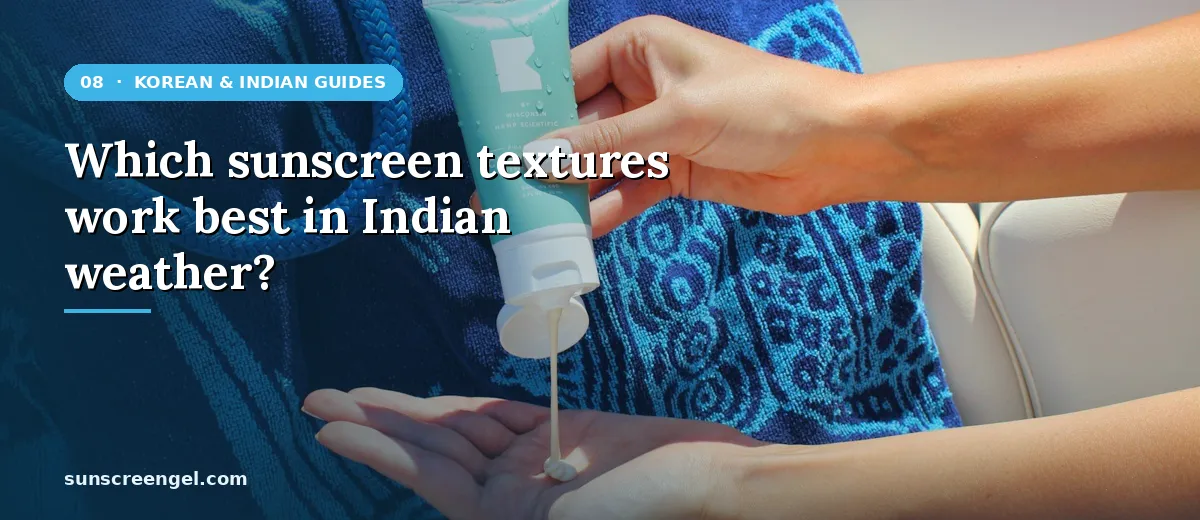
Light gels and fluids work best for most of India in summer and monsoon. Richer creams and milks suit dry winters in the north.
For example, Mumbai and Kolkata stay humid for months, so a gel avoids that sticky film. Delhi and Jaipur bring dry heat in May and June, then cold, dry air in December. Bengaluru is milder, but the UV can still be strong at midday. Plus, coastal Chennai and Kochi make sweat resistance useful.
The World Health Organization advises sun protection whenever the UV index is 3 or above. Across India, that is most daytime hours. If you like the Korean gel feel, our guide to gel sunscreen explains who it suits.
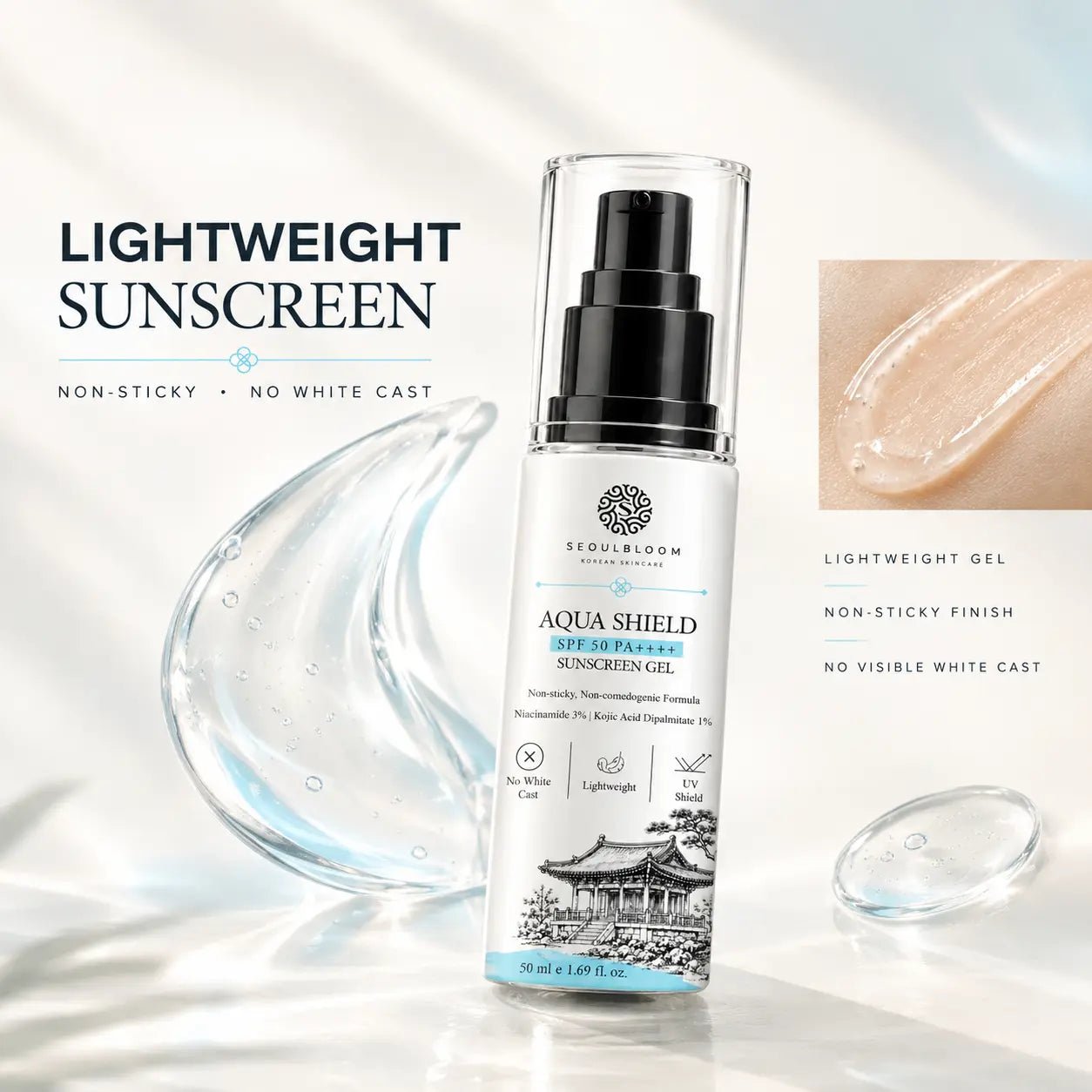
If you want a Korean-inspired gel made with Indian heat in mind, one option is our own formula below. It is a light gel with SPF 50 PA++++, no white cast and 3% niacinamide.
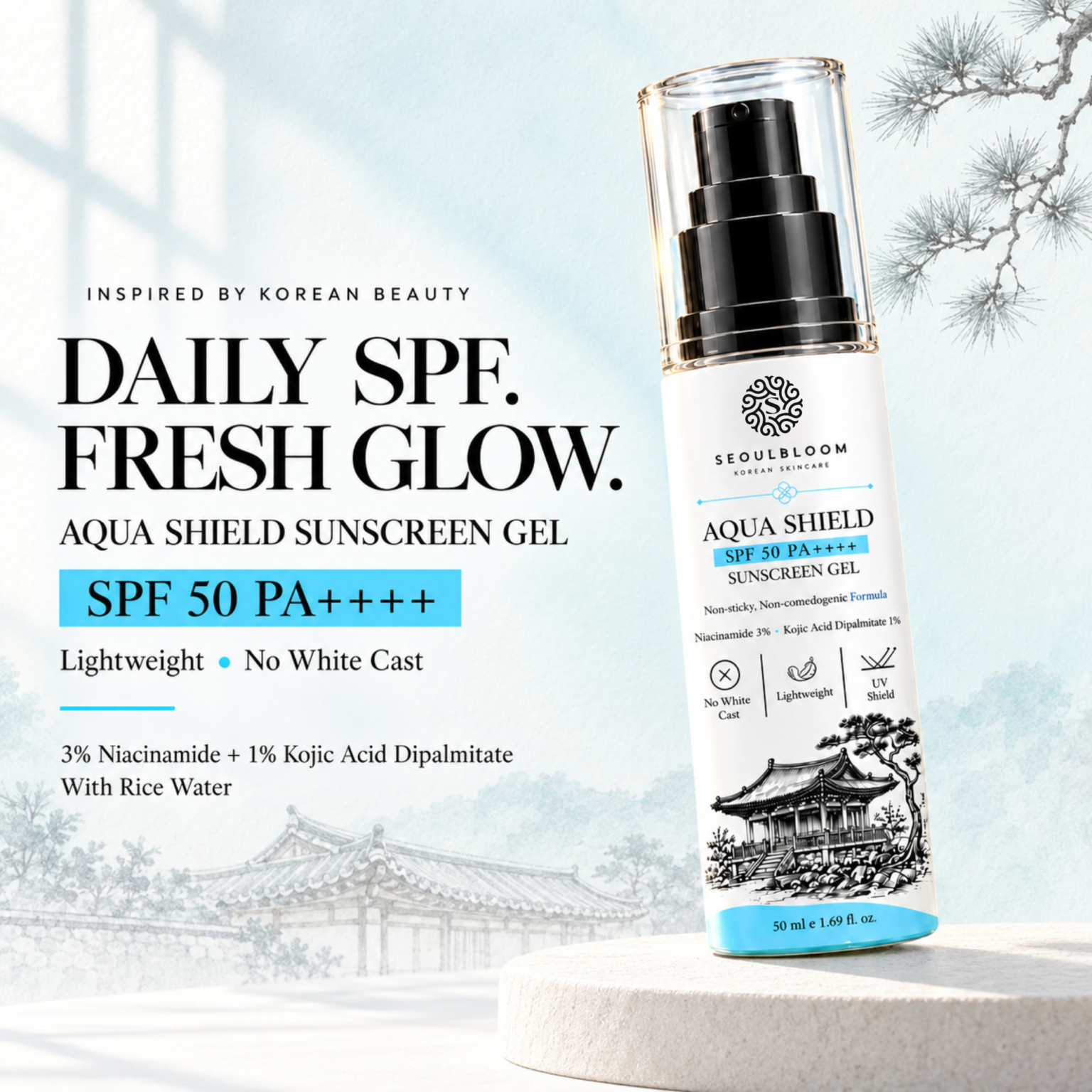
Our pick
SeoulBloom Aqua Shield SPF 50 PA++++ Sunscreen Gel
- SPF 50 PA++++ broad-spectrum UVA/UVB protection
- Lightweight, non-sticky gel — no white cast
- Non-comedogenic; suits oily & combination skin
- 3% niacinamide + 1% kojic acid dipalmitate for even-looking tone
- 60 ml · ₹799
₹999
How much Korean sunscreen should you apply on your face?

Apply about a quarter to a third of a teaspoon of Korean sunscreen to your face alone. That roughly matches the 2 mg per square centimetre used in lab SPF testing.
Most people use far less. According to research summarised on Wikipedia, people often apply only a quarter to half the tested amount. As a result, real protection can fall well below the number on the tube. Watery textures make this worse, because a few drops feel like plenty.
- Cleanse and apply your usual moisturiser, then wait a minute.
- Measure about a quarter teaspoon of sunscreen, or two full finger lengths for a cream.
- Dot it over the forehead, cheeks, nose and chin.
- Spread evenly, including the ears, neck and hairline.
- Wait about 15 minutes before stepping out, as the ACS advises.
- Reapply every two hours outdoors, and after sweating or swimming.
The American Academy of Dermatology also recommends a broad-spectrum, SPF 30+ product and water resistance when you will sweat. If you are building a full routine, see this simple Korean morning routine.
How often should you reapply sunscreen in India?
Reapply at least every two hours when you are outdoors, and right after sweating, swimming or towelling off. Water-resistant labels last only 40 or 80 minutes in water or sweat.
Indoors, one generous morning layer is usually enough if you sit away from windows. But if you work near glass or commute by bike, top up at lunch. Over makeup, a sun stick, cushion or spray helps. Still, these touch-ups rarely deliver the full labelled SPF, so treat them as a boost, not your main layer.
Also remember that sunscreen is one tool among many. The WHO says shade, clothing, hats and sunglasses come first, and you should not use sunscreen to stay out longer.
How can you spot a fake or expired Korean sunscreen?
Buy Korean sunscreen only from the brand’s official store or an authorised Indian retailer, and check the batch code, seal and expiry date. Counterfeits are common with imported beauty products.
- Check for an Indian importer label with name and address.
- Compare packaging fonts and colours with the brand’s official site.
- Be wary of prices far below the usual rate.
- Smell and texture should match earlier tubes; discard anything separated or rancid.
Also, sunscreen does not last forever. The ACS notes most products work for about two to three years. However, heat, such as a parked car in an Indian summer, can weaken them sooner.
What mistakes do people make with Korean sunscreen?
The biggest mistake with Korean sunscreen is using too little because the texture feels so light. Other common errors are easy to fix.
- Ignoring the PA rating and buying on SPF alone.
- Skipping the neck, ears and back of the hands.
- Relying on SPF makeup or a cushion as the only layer.
- Skipping sunscreen on cloudy monsoon days, even though UV still gets through.
- Choosing a dewy formula for very oily skin, then giving up when it feels greasy.
Children have different needs. The FDA does not recommend sunscreen for babies under six months, so ask a paediatrician before using any product on young children.
Our verdict: is Korean sunscreen worth it for Indian skin?
Yes, a Korean sunscreen can be worth it if it has SPF 30+, PA+++ or PA++++, and a texture you will wear daily. But a well-made Indian gel with the same ratings protects just as well.
In short, buy on label, finish and comfort, not on origin. Apply a full quarter teaspoon, reapply outdoors and add shade when the sun is harsh. Above all, consistency beats any single “holy grail” tube. For every other sun-care question, start at our sunscreen topics hub.
Frequently asked questions
Is Korean sunscreen good for Indian skin?
Yes, many Korean sunscreens suit Indian skin, especially light gels and fluids with SPF 30+ and PA+++ or PA++++. Choose a finish that matches your skin type and patch test first.
Which Korean sunscreen is best for oily skin in India?
Look for a non-comedogenic gel or fluid with a matte or soft finish and PA+++ or higher. Avoid dewy creams with heavy oils, especially in humid cities like Mumbai.
Is Korean sunscreen safe to use every day?
Yes, sunscreen is meant for daily use. If you have sensitive skin, pick a fragrance-free formula and patch test. See a dermatologist if irritation continues.
What does PA++++ mean on Korean sunscreen?
PA++++ means very high UVA protection, with a PPD value of 16 or more. UVA drives tanning, pigmentation and skin ageing, so it matters a lot for Indian skin.
Does Korean sunscreen leave a white cast?
Most chemical and hybrid Korean formulas leave little or no white cast. Some mineral formulas with zinc oxide or titanium dioxide can look grey on deeper skin tones.
Can I use Korean sunscreen under makeup?
Yes. Let it set for a few minutes before makeup. For touch-ups, use a sun stick or cushion, but do not rely on these as your only layer.
Is Korean sunscreen better than Indian sunscreen?
Not automatically. Both can protect well. Compare SPF, PA rating, texture and price rather than country of origin.
How we researched this guide: We reviewed the top-ranking Indian and international pages for ‘korean sunscreen’ and ‘best korean sunscreen in India’, including LBB, DesiDime, Harper’s Bazaar India and NBC Select, and noted gaps such as missing PA explanations and application amounts. We then checked every protection claim against the American Academy of Dermatology, American Cancer Society, FDA and WHO guidance. Read our editorial policy.
Sources & further reading
- American Academy of Dermatology: How to select a sunscreen
- American Cancer Society: How to use sunscreen
- FDA: Sunscreen – how to help protect your skin from the sun
- WHO: Ultraviolet radiation fact sheet
- Wikipedia: Sunscreen (PA system and application amount)
- NBC Select: Korean vs American sunscreens, dermatologists explain
- The Korea Times: US approves new UV filter

Written & fact-checked by
SeoulBloom Editorial Team — the skincare research and product team behind SeoulBloom. We formulate and sell sunscreen for Indian skin, test textures in Indian heat and humidity, and check every claim against dermatology bodies (AAD, WHO) and peer-reviewed research. Updated 20 November 2026. How we write & review.
Disclosure: SunscreenGel.com is run by the team behind SeoulBloom, and we link to SeoulBloom products where they fit. This article is for general education, not medical advice — see a dermatologist for skin conditions. Read our disclaimer. Last reviewed November 2026.